When was the last time you heard that snowmen could actually be built in Amsterdam? Perhaps decades ago. Snow in this city is usually a fleeting visitor, a whisper of winter that melts before you can even step outside. But now, ten centimeters have fallen overnight, stubbornly clinging to streets, rooftops, and canals alike, transforming familiar corners into something almost unrecognizable, magical and treacherous at once.
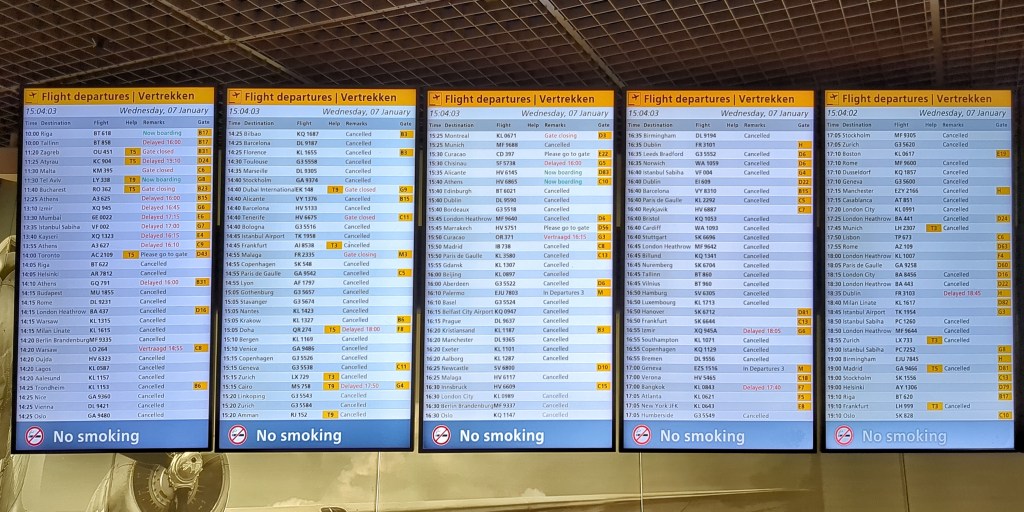
The city’s usual rhythm has faltered under this sudden weight. Trains aren’t running, and the roads have turned into sheets of ice. Every slip of a tire, every shivering pedestrian, seems to echo the quiet chaos unfolding. At Schiphol, the airport, the storm’s reach is even more tangible. De-icing capacities are overwhelmed, crews are stranded, aircraft sit out of position, engines idle as the ground staff struggle to regain control.
Half the night I keep scanning the airport website and the airline app, my fingers hovering over the refresh button, growing more restless with each update. How is it decided who gets to fly? Eeny, meeny, miny, moe? Surely not. And yet, while some European flights are understandably canceled because of the storm, not all long-haul international flights are grounded. The logic is invisible, arbitrary, or perhaps hidden somewhere between the hands of the weather and the schedules of men.
While the journalist in me begins to draft interview questions for airport officials, the rest of me asks something far older, far quieter: What is fate, really? Is it a thread woven before birth, invisible but unbreakable? A subtle nudging of the universe toward certain outcomes, or merely the stories we tell ourselves to make sense of randomness? I’ve always believed in the small intersections, the glances and chances that feel like guidance. Perhaps fate is nothing more than attention, carefully paid. Or perhaps it is something more — a force beyond comprehension, gentle yet insistent, nudging you toward moments you could never have orchestrated. Is it fate that I am flying to India? I have dreamed of it since I was sixteen. Did one of the Indian deities glance at my file, tilt their head, and decide: “Well then. It’s about time”?
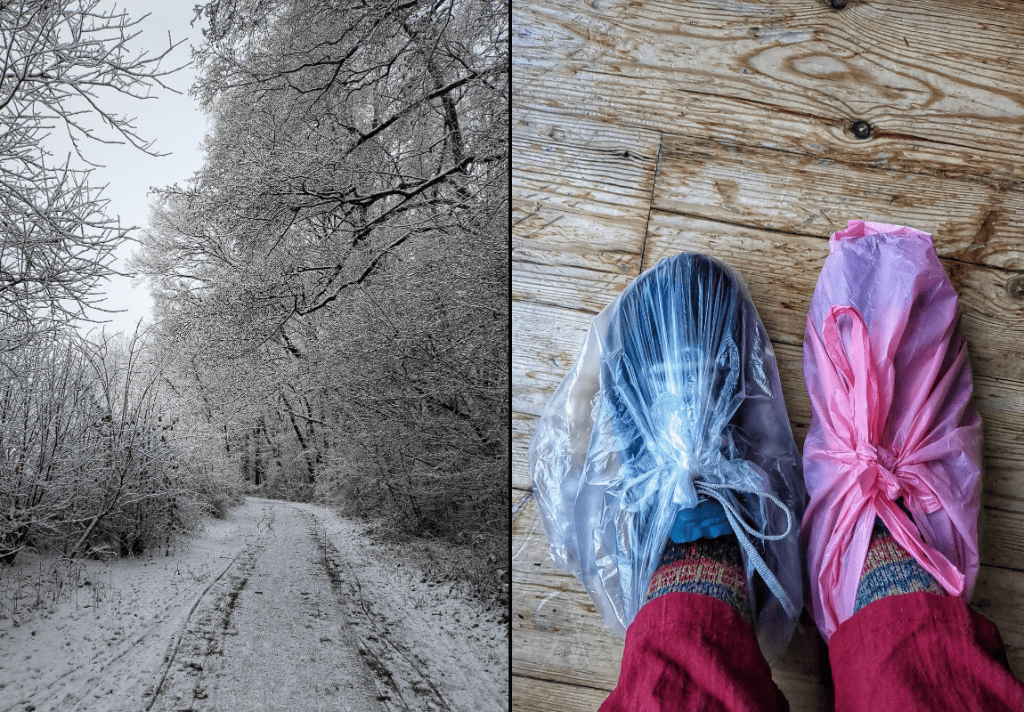
If you are traveling with Trailrunner shoes in the middle of a snow storm you better get creative.
Accordingly I can not but wonder if fate put this Uber Driver up for the task of taking me to the airport. He doesn’t speak a word at first, blasting music so loud that the car itself seems to vibrate with anticipation. I settle into the rhythm, easing into the prelude of this journey. Then, suddenly, he turns the music off and begins speaking — about Jesus, about love, about faith. It hits me like a verbal piñata, showering me with words I am not meant to parse, but to feel. There are moments when I want to agree, or contradict. But no. That’s not how this works. He is not speaking with me, but to me. He is not offering conversation; he is offering a lesson. And so I give in — fully, without reservation, smiling at the strange, vivid wonder of it all.
At the airport, I wait for seven and a half hours. I wander slowly through the long, echoing halls, my footsteps muted against the polished floors. I drift past cafés and newsstands, past travelers hunched over laptops or staring blankly at their phones, faces a mix of frustration and quiet resignation. My eyes keep returning to the departure boards, scanning flight after flight, hoping to catch my own status change, any hint of movement, any small sign that I will leave after all. The numbers flicker and shift, cancellations multiplying, delays stretching further into the evening, a constant reminder that none of this is in my control.
And than. I stop.
Today alone, 600 flights have been canceled.
Six hundred.
So many people. So many stories.
Instead of worrying, I stop.
And I meet some of them.
A psychologist on his way to Cape Town, because, he says, people there still know how to appreciate the small things. A Scot who lives in Bangkok and is flying home for his father’s funeral. And a woman from Lisbon. Traveling alone, carrying a violin case much too large for hand luggage. She doesn’t talk much. Just tells me she hasn’t played in weeks. “What’s the point,” she shrugs, “when everything is on hold anyway.” Her words carrying a sadness that reaches far beyond a delayed holiday.
None of them will fly today. Some of them have been waiting since Monday.
In the end I find myself grateful for this lesson. The frozen city, the stalled flights — invite me to do one thing, and one thing only:
Surrender.
Not resignation. Not giving up. But a conscious loosening of control. Letting go of the need to understand, to predict, to steer. Allowing myself to be carried — by weather systems, by strangers, by timing that is not mine. Trusting the path, however crooked, however delayed.
At 6:45 p.m. European time, my plane lifts off from dutch soil.
I have never felt more ready.
 An unmapped life
If you feel like responding, I’m listening.