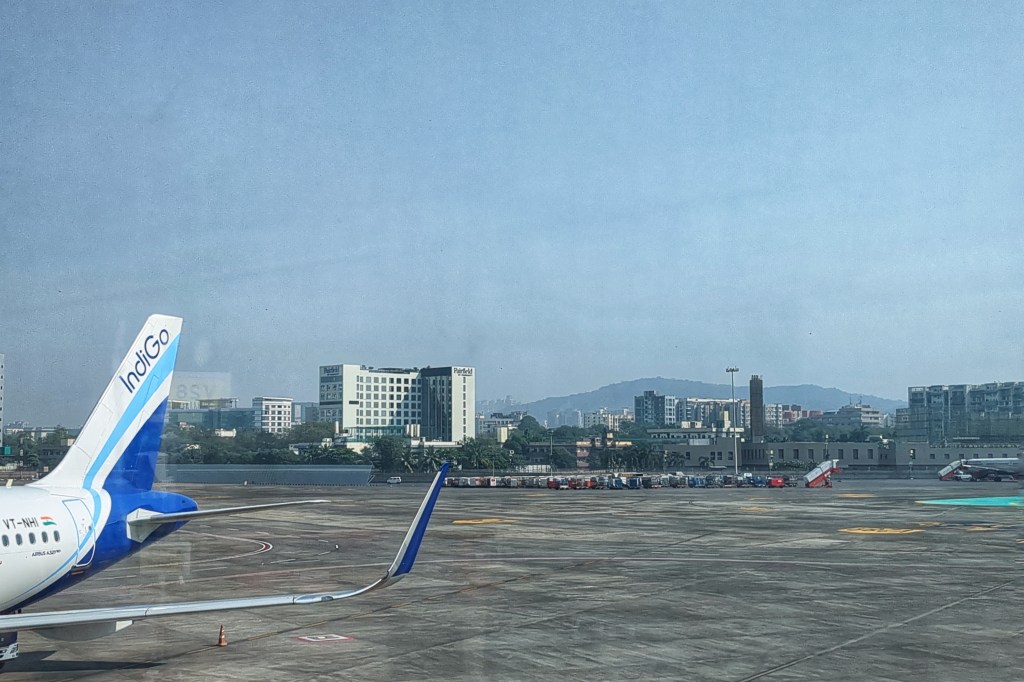
We land at 7:02 a.m. in a hazy Mumbai. Not with a bang, not with revelation — just with wheels on tarmac and the dull thud of arrival. I am in India. At least technically.
Friends had told me what it would feel like. The first smell. The sensation of Mother India. The noise, the immediacy, the overwhelm. But there is no time for any of that. No space to arrive. Instead, I am busy not being where I am. My connecting flight to Chennai has been in the air for forty minutes — without me on board.
Arrival is not an event. It is a process that refuses to be rushed. And for now, it politely declines.
Half an hour after landing, overtired and slightly disoriented, I find myself standing in a long immigration line, passport and visa in hand. A colorful mix of nationalities and ages surrounds me. I choose the queue for e‑visas. And I learn something immediately: the concept of cutting in line does not exist in India the way it does where I come from. People step in front of me. Or in front of the Indian gentlemen next to me. The act isn’t even acknowledged — no shrug, no irritation, no eye‑roll. As if everyone assumes: if this person steps ahead, they must have a reason. I like that. It feels kind. And above all, I like kindness.
When it’s my turn, I expect questions about my stay. But instead, the man behind the counter looks at me and asks if I am in love.
I say yes.
He smiles broadly.
I smile broadly.
For a brief moment, this seems to be the only credential that matters. Not how long I will stay, not where I will go, not what I plan to do — just this simple, human truth. As if love itself were a valid visa. Immigration in India.
A country where the heart seems to speak before the paperwork.
At 8:20 a.m., backpack in hand, I head toward what I believe to be the terminal for my connecting flight. At the bus transfer area, hundreds of people are waiting. Luggage. Noise. Momentum. Somewhere in between, I learn that I need a current boarding pass. Without it, no transfer. An hour later, I am standing in the farthest corner of a parking garage, having crossed Terminal 2 in search of Terminal 1 — only to discover that I never needed the transfer at all. My flight departs from Terminal 2. I check in my bag again. Security again. More waiting. Another boarding.
The flight is scheduled for two hours. We spend nearly one of them not flying at all. Mumbai operates with a single main runway, yet on average more than 900 flights take off and land here every single day. Planes queue like beads on a string, inching forward, waiting for their turn. Efficiency stretched to its absolute limit.
By now, I am so tired that I try to sleep with my head resting on the fold-down table. The Indian woman next to me does the same. Faces squashed against forearms, we smile at each other — a quiet, conspiratorial moment of shared exhaustion.
When I close my eyes, I check in with myself.
How am I? What do I feel?
Calm.
Tired.
Empty.
The tension and excitement of the past weeks have dissolved into something else — a still, inner lake. In the short intervals of sleep, I meet an Indian deity for the first time.
Before the journey, I had tried to familiarize myself with the pantheon. But the sheer abundance eventually overwhelmed me. I gave up and decided, as with so many things, to simply let it come to me. And now it does: the image of a monkey god standing by my side. I cannot place it precisely. There is simply this feeling of safety. Of being watched over.
Later, I read up on it.
Hanuman — the god of travelers, devotion, courage, and loyal service. A protector of those on long journeys, especially when the path is uncertain. A symbol of strength not born from force, but from faith and humility. It fits. Quietly. Perfectly.
In Chennai, I am greeted by a radiant Willem Jan. An Uber takes us to Mamallapuram, where we will spend the next two nights. With eyes wide open, I watch the landscape pass by. Sounds and smells rush toward me. When I close my eyes, it is still there — that same deep inner stillness.
I find myself slightly puzzled by it. Wondering why there isn’t more. More emotion. More intensity. More overwhelm. As if arrival should feel louder, more dramatic. Then I smile at myself. This expectation, too, is a habit — a psychological reflex, measuring experience against imagined reactions instead of simply letting it be what it is.
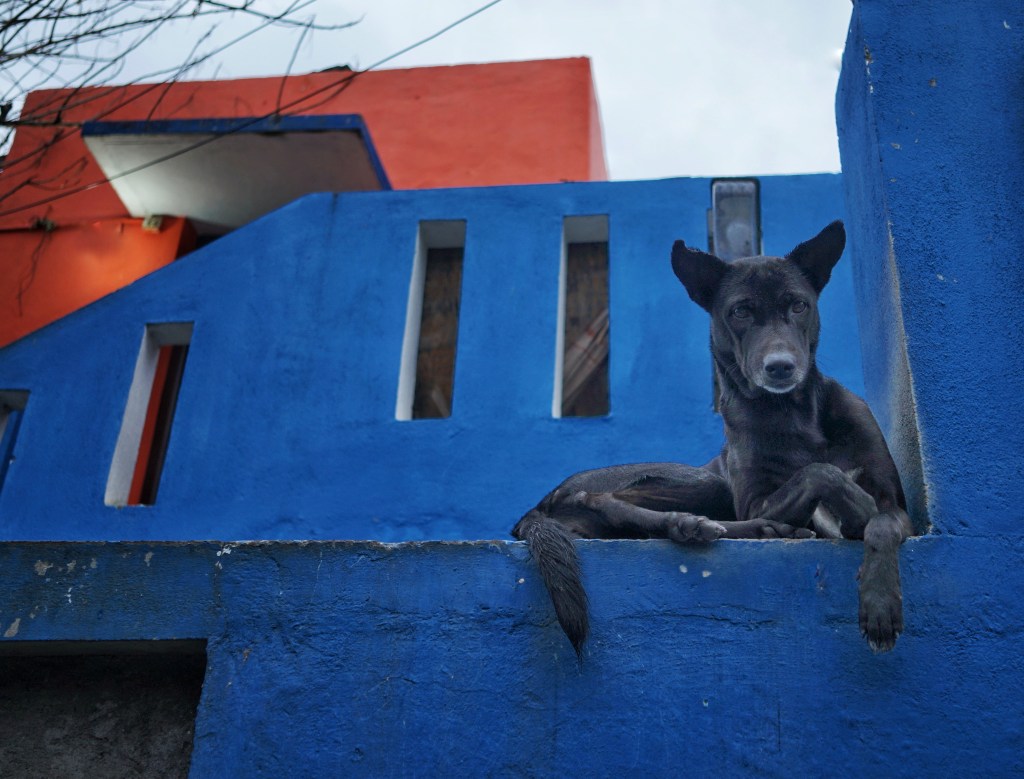
Instead of roaming the streets of India, I spend the next days almost exclusively in bed. I am tired from the long journey, of course. But that is not all. The scratchy throat I had felt for days turns, thanks to air-conditioning and airport air, into a full-blown, relentless cough. I rest. I slow down. And as a result, I see very little of Mamallapuram — despite how good everything I do see and feel seems to be
Mamallapuram is a creative fishing town south of Chennai, famous for its stone sculpture traditions. Everywhere, artisans sit by the roadside, carving soapstone with calm concentration. Along the main roads, larger workshops display massive stone figures — gods, animals, guardians — in various stages of becoming. I glimpse it all only briefly, during slow, careful walks.
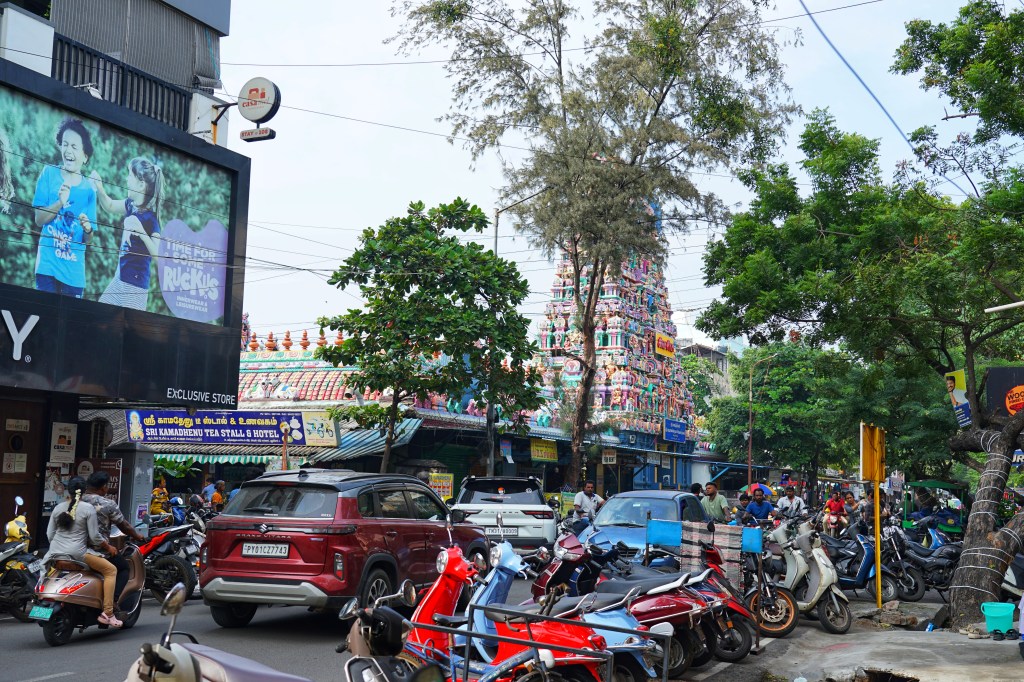
On the third day after my arrival in India, we travel on to Pondicherry by taxi. We had planned to take the bus, but by now my cough has been joined by fever and chills. I hardly sleep. Every time my head touches the pillow, mucus finds its way through my sore throat and forces itself out violently. When my lungs begin to burn on day four, we go to a hospital.
The receptionist, who seems to be managing all newcomers to the emergency room, looks at me critically.
“What do you have?”
“A bad cough and fever,” I answer. Without a word, she gestures for us to sit down. Minutes later, she returns with a thermometer.
The fever is done for now. Which apparently qualifies me to enter door number one — where a round, smiling doctor awaits. He motions for me to sit on an old, dark-brown wooden chair so close to him that our knees touch. He shines a flashlight into my throat, palpates my lymph nodes, listens to my lungs. “Severe bronchitis,” he announces cheerfully.
Then adds: “You have reached India now.” With great enthusiasm, he tells me the story of another young patient he recently treated, who also reached India. Severe diarrhea.
“She called her mum. ‘Mummy, mummy, it won’t stop, it is running and running.’” He illustrates the motion with his hands, animated and delighted. I sit there, astonished, slightly embarrassed, and deeply amused. I have never seen anyone talk about diarrhea like this — let alone a doctor. Completely free of shame.
Then he grows serious. He explains what I need to pay attention to over the next few days. The bacteria and viruses here are immune. I am not. I should avoid Indian food for now. Keep my hands off street food. My immune system is already working hard enough. Then he laughs again.
“We don’t want you to get diarrhea as well.”
I shake my head shyly.
No.
We really don’t.
After all the turmoil and the uncertainty my body has arrived, at last.
And somehow for now this is enough.
 An unmapped life
If you feel like responding, I’m listening.