Weeks before we entered Mother India, Willem Jan spoke about his wish to visit Rajasthan. Never having heard of the region before (or knowing any of India’s regions whatsoever at that point), I started reading about it. I remember having eight books on my shelf, all dedicated to India — and by then still Thailand, although we very soon scratched it from our itinerary entirely. Jaipur, Udaipur, Mount Abu — so many new names. Already then, Jaisalmer stood out. There was no question that we would go there next after Pushkar.
I didn’t yet know what exactly it was that pulled me there. I assumed it was a mix of the desert landscape and the close proximity to the Pakistan border, which made it culturally and historically a fascinating location. The border between India and Pakistan is not just a line on a map — it’s the result of the 1947 partition, when British India was divided into two nations, triggering one of the largest migrations in human history. Millions were displaced, families separated, identities reshaped overnight. Rajasthan, and especially regions like Jaisalmer, found themselves at the edge of this newly drawn boundary. Trade routes that once connected communities were interrupted, yet traces of this shared past remain visible — in architecture, in food, in language. Life here still carries echoes of both separation and connection, shaped by a history that is never entirely in the past. But of course, Mother India had more in store for us than geopolitics alone.
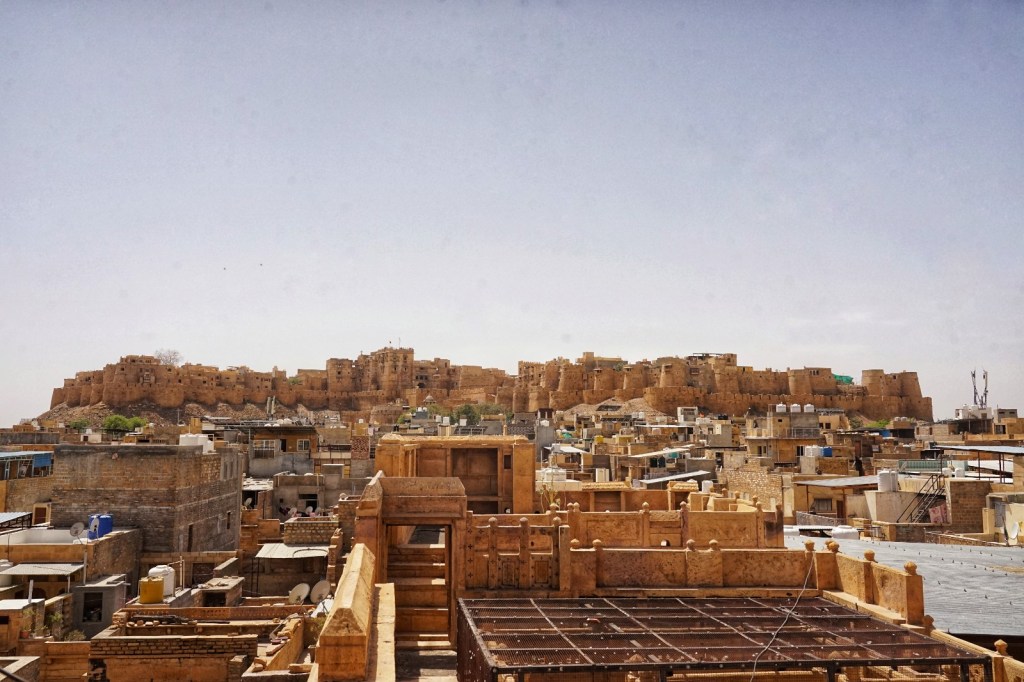
To reach the so-called Golden City in the heart of the Thar Desert, we traveled around 13 hours by bus and train via Ajmer. By now, we have found a rhythm — how to pack, how to catch a rickshaw, how to navigate bus and train stations. This time, the train ride is during the day, and we spend it playing cards, reading, eating, and dozing off now and then. Amused, I notice how distances and timespans like these would once have overwhelmed me. Now, I simply see them as part of traveling — and even welcome their pace. Because it gives me the chance to reflect, to reconnect with whatever is present in that moment. A plane might be faster, but it also robs you of this. Almost like a decompression chamber.
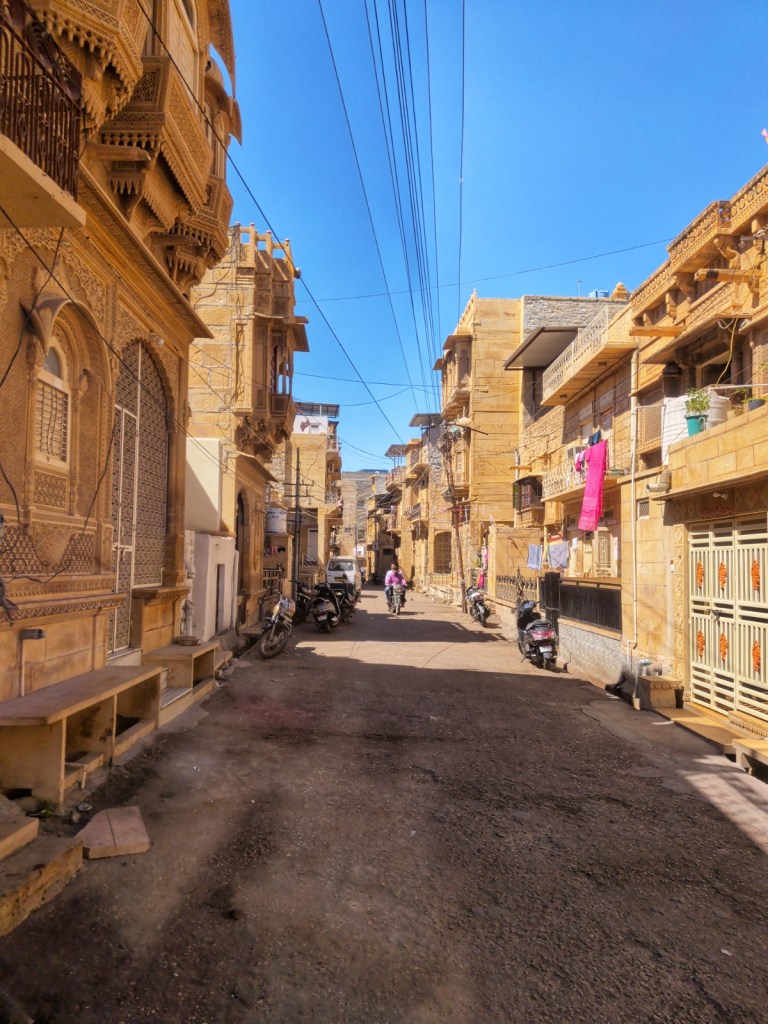
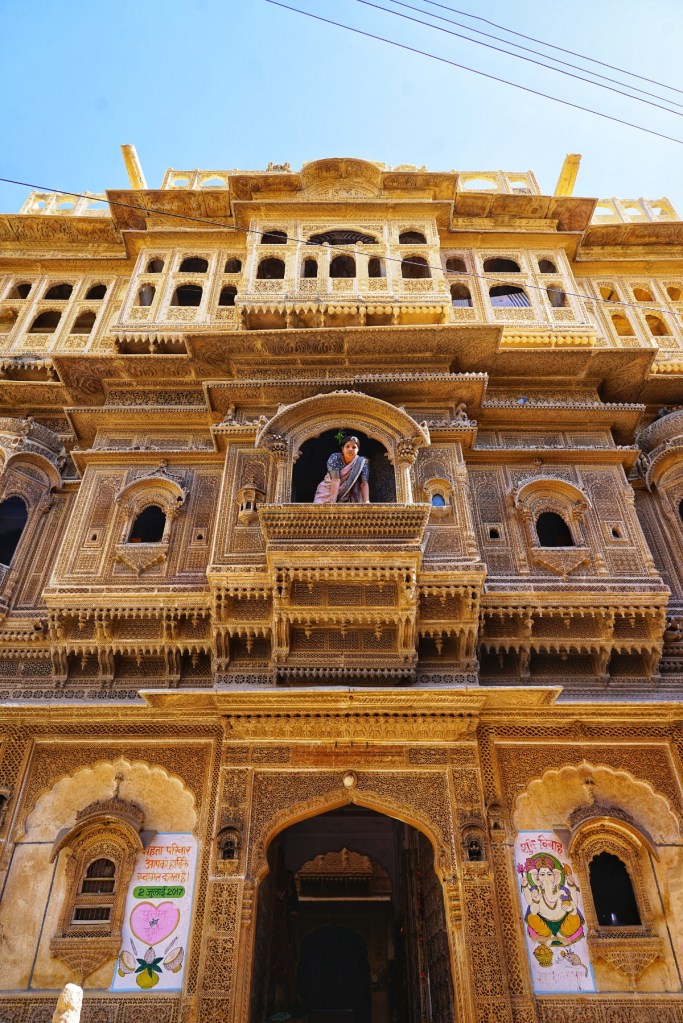
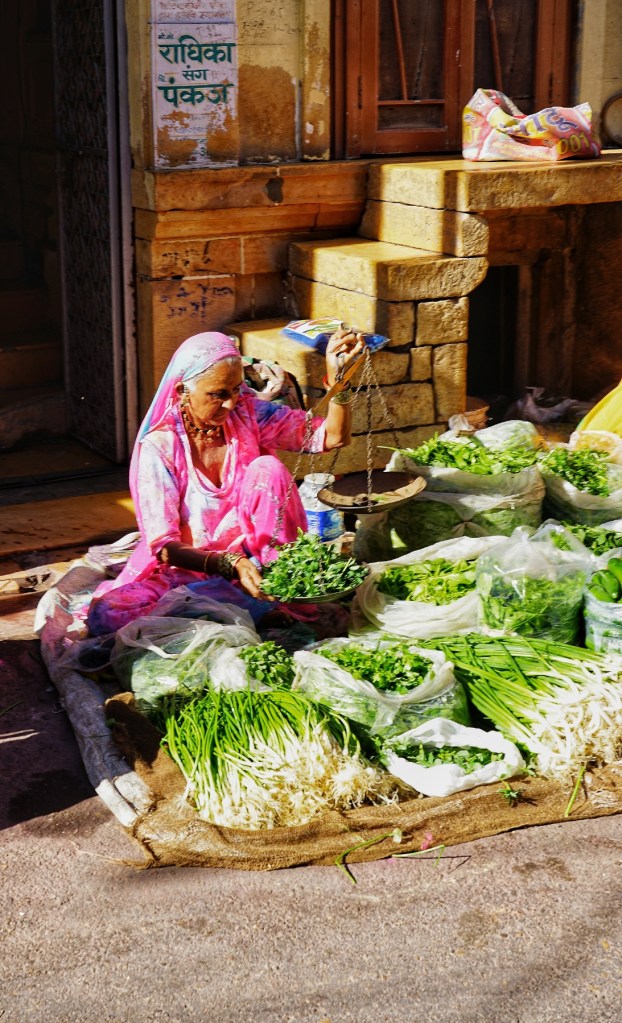
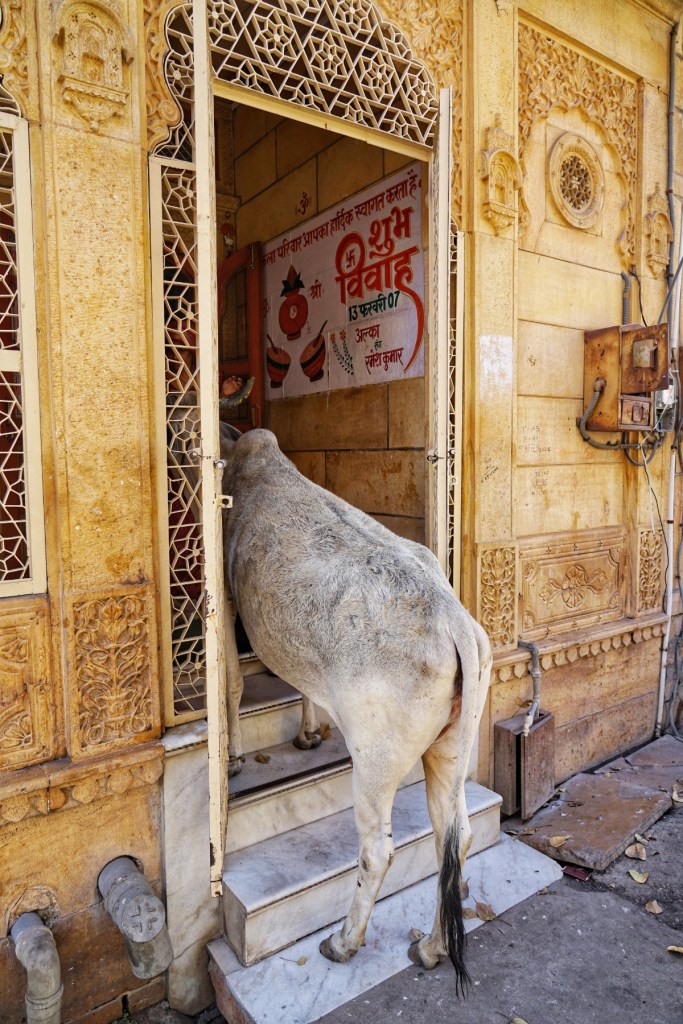
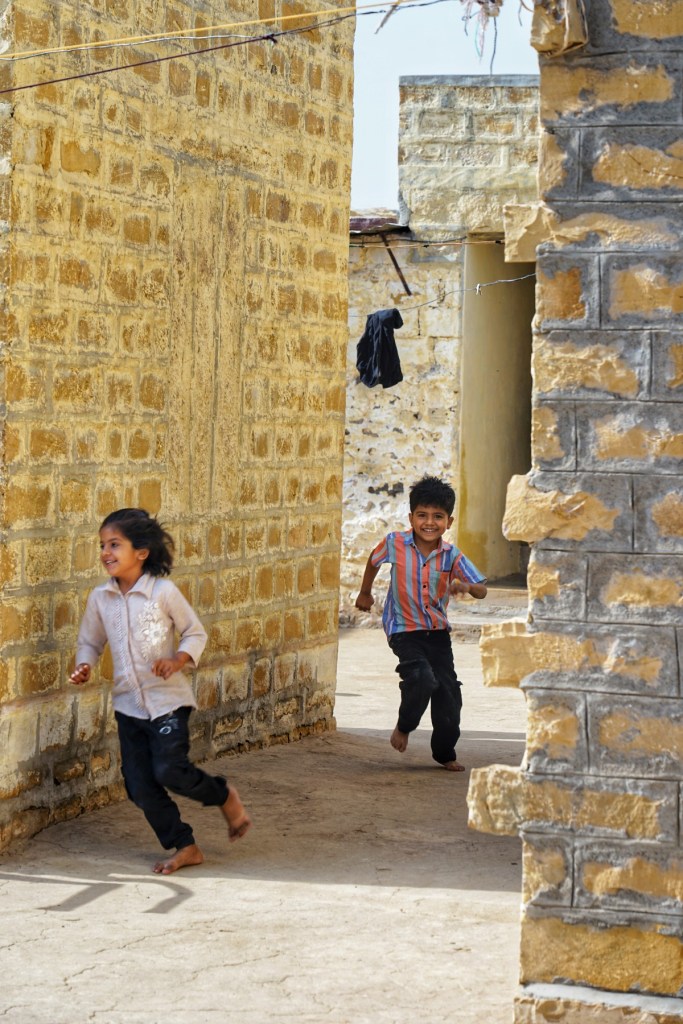
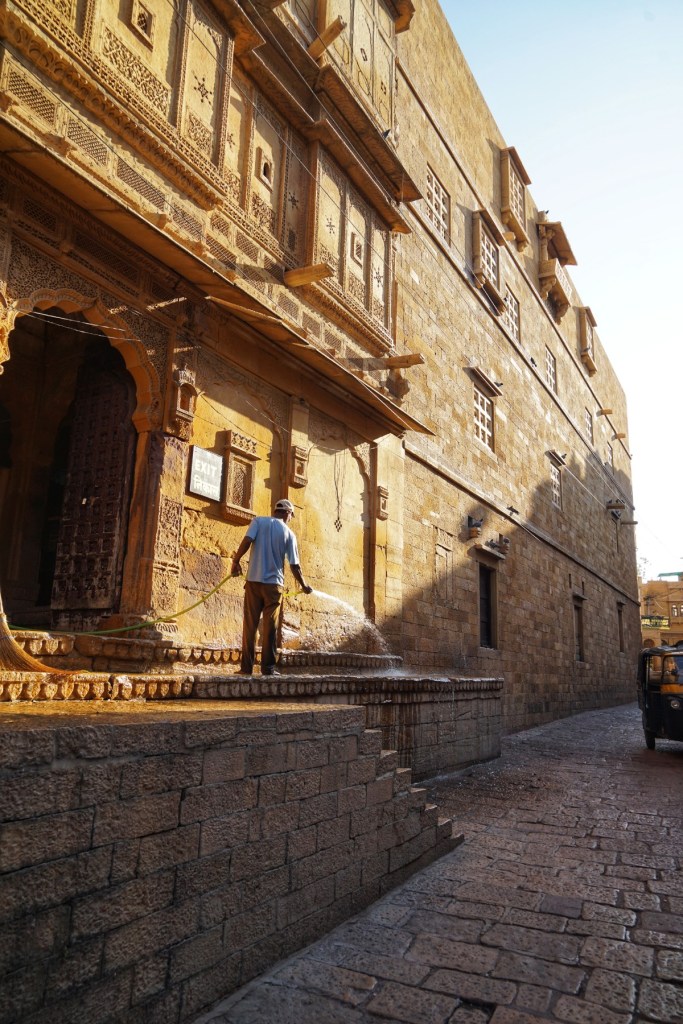
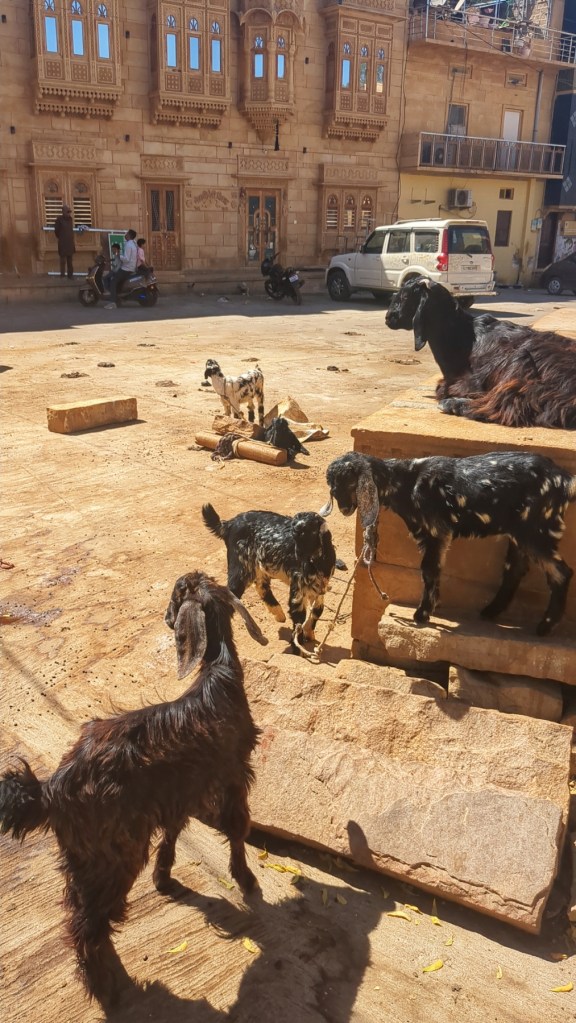
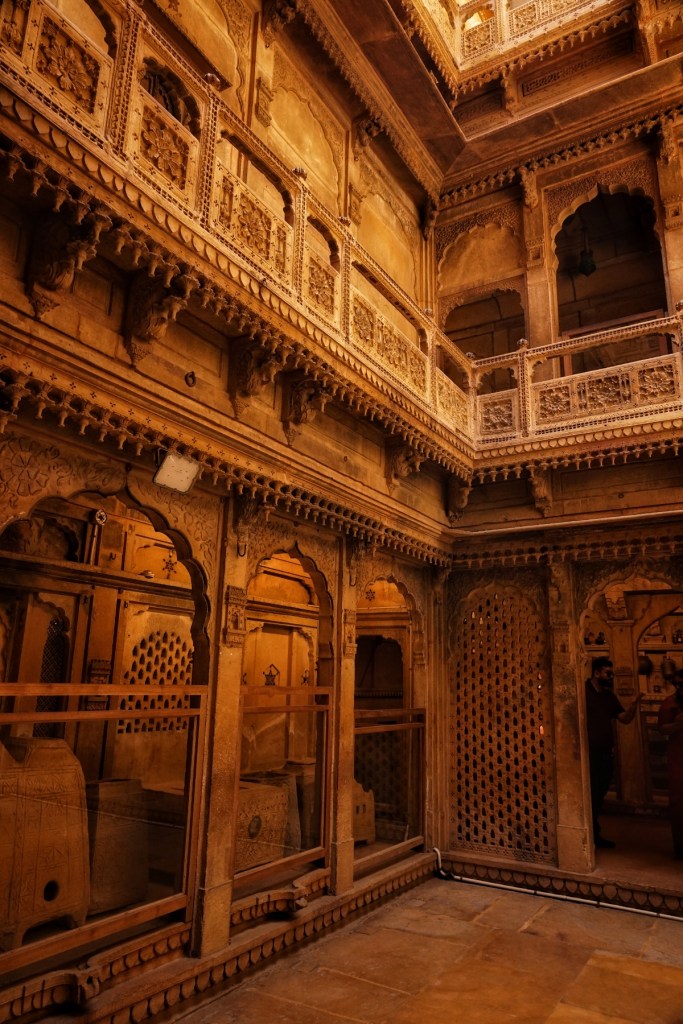
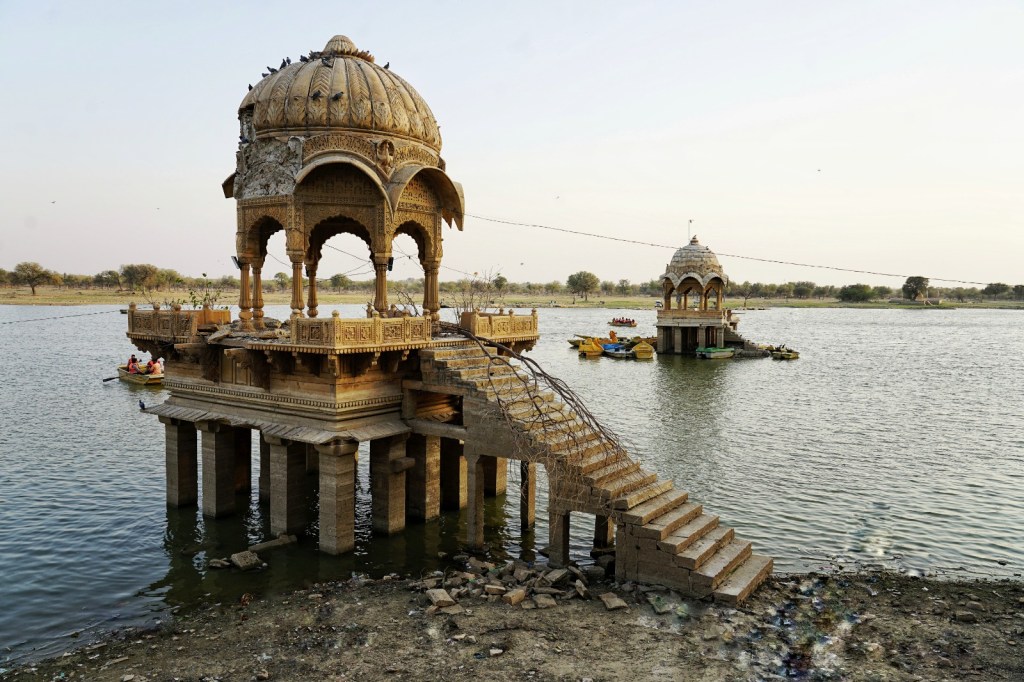
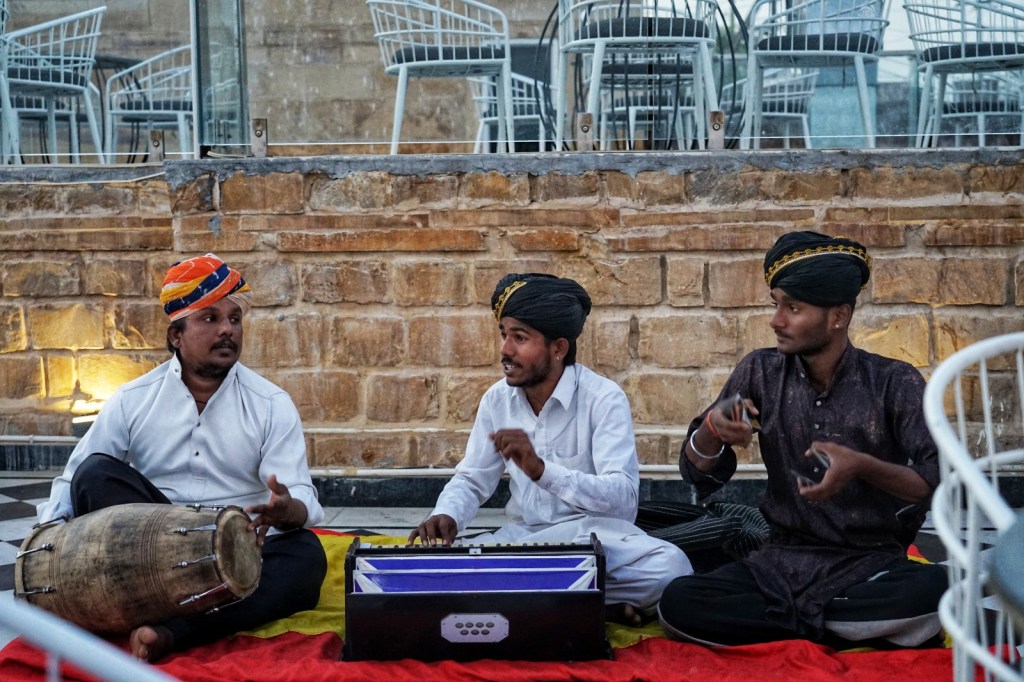
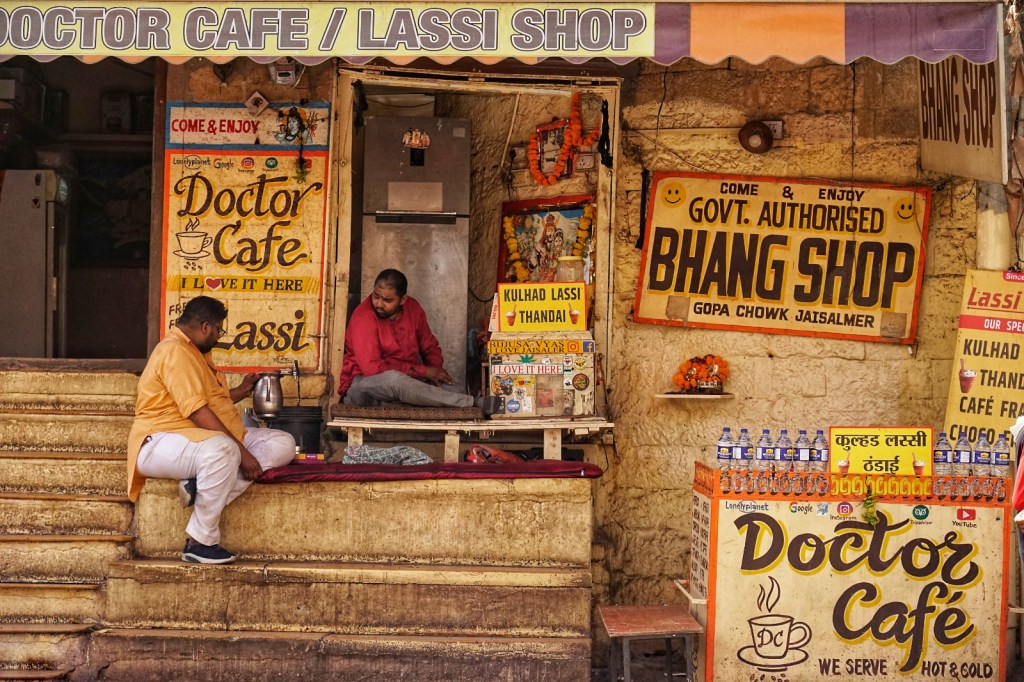
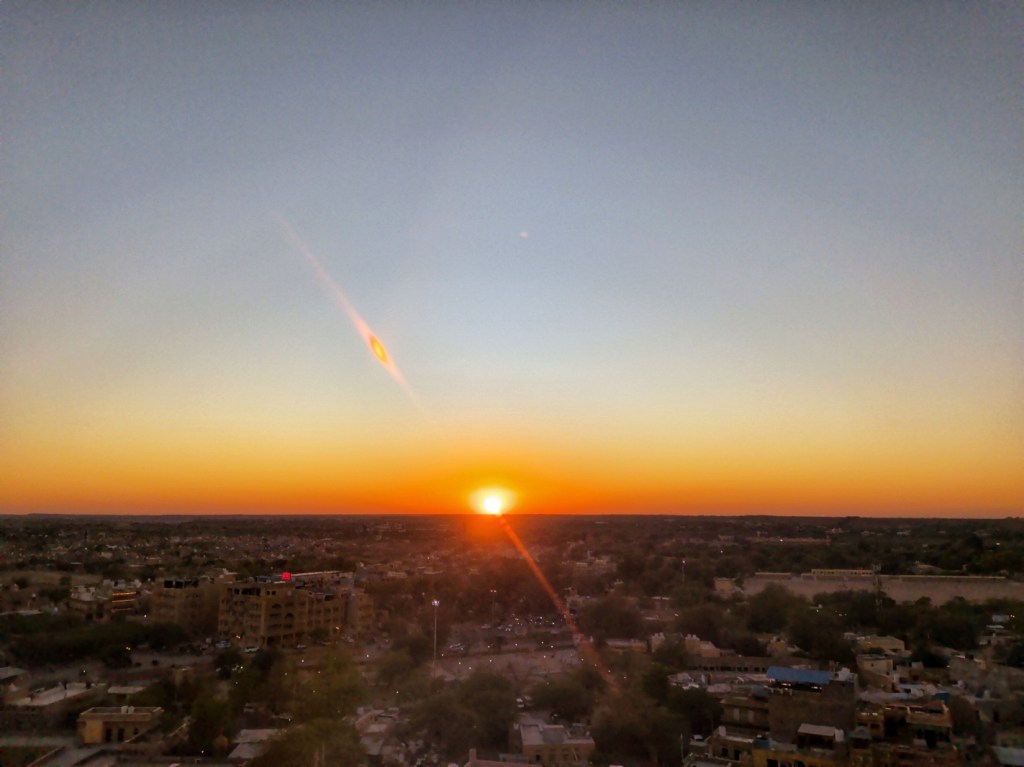
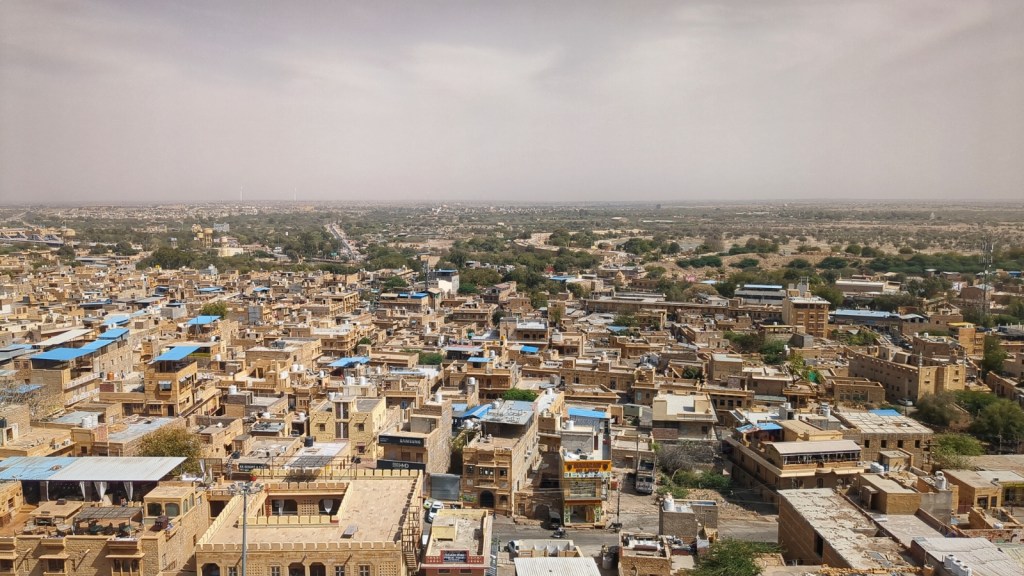
Our first place to stay in Jaisalmer lies outside the Fort area — a small hotel with (very) tiny, cute rooms that are surprisingly cool, considering the 45 degrees the city welcomes us with. For the first few days we make our way into the Fort passing through crowded streets with dogs, cows, and scooters that once again challenge my patience — and my resilience for the ever-present honking. And there we experience what makes Jaisalmer feel so distinct. It is how seamlessly history and everyday life blend into one another. Laundry hangs between ancient walls, children run through narrow lanes, motorbikes squeeze past intricately carved facades. The Hawelis, with their delicate stone latticework, seem almost too detailed to be real, like something imagined rather than built. At its center lies the Fort. It is not a monument frozen in time — it breathes. And then there is the desert itself — never far, always present — shaping the rhythm of life with its heat, its stillness, its vastness.
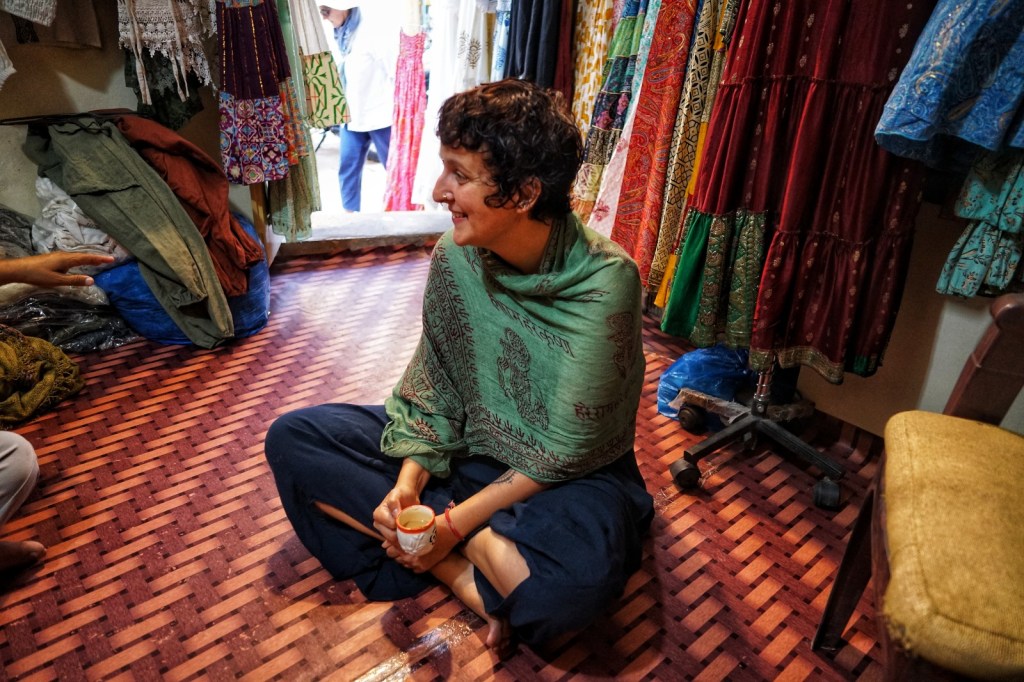
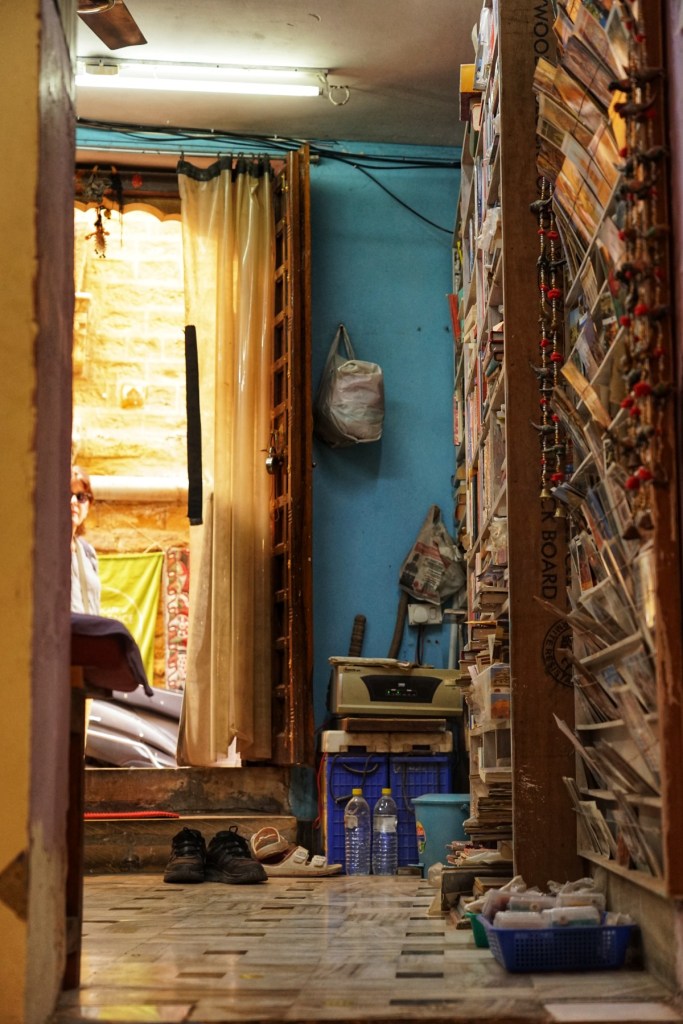
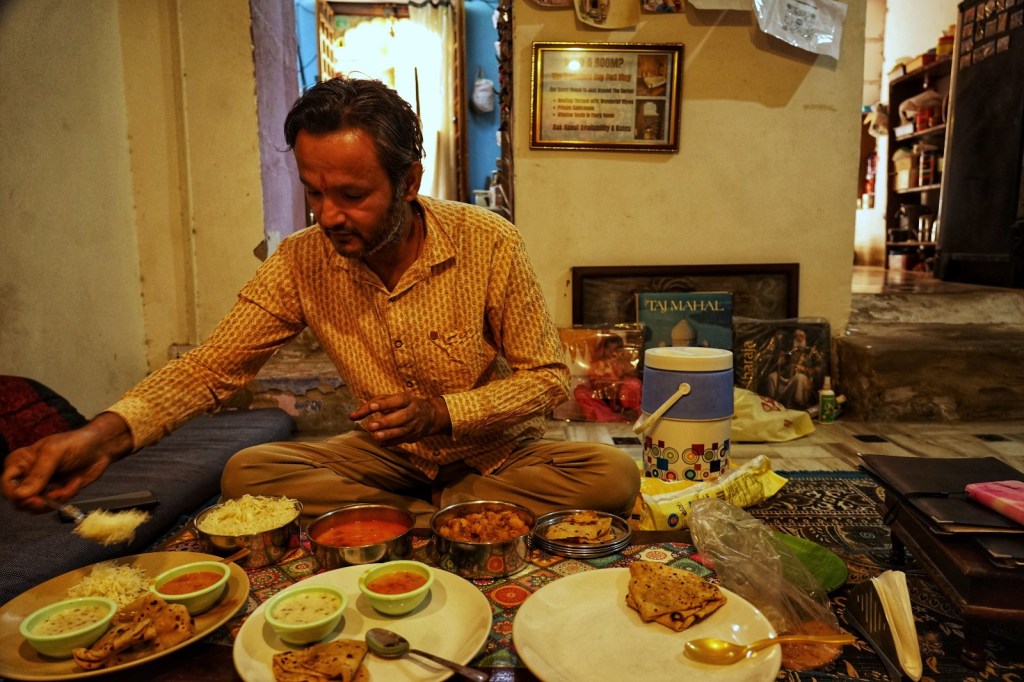
On our second day, I lead us to a place inside the Fort that I had marked beforehand. I found it on someone’s blog, or Instagram, or Tripadvisor. Maybe someone recommended it, or maybe it was just instinct guiding me. I can’t quite remember. But it truly felt like a gift to find The Traveler’s Cup. A small coffee place with honest food, good prices — and yes, they are not lying: the best coffee in Jaisalmer, as Willem Jan immediately notes. In the coming days, this place becomes more than just a hiding spot from the sun, where we sink into cool cushions and drift into long conversations. With every encounter, the connections deepen. What begins with small talk over coffee slowly unfolds into something more personal. We linger longer, return without planning to, are recognized, welcomed back. Stories are shared — not all at once, but in fragments, over time. There’s a quiet kind of hospitality here, one that doesn’t try too hard, yet stays with you. At some point, we find ourselves helping with their Tripadvisor page, sitting behind a laptop in the afternoon heat. Another evening, we are invited to eat a home-cooked meal, prepared by the owner’s wife. It feels less like visiting a place, and more like being gently folded into it.
For your kind information: they also offer beautiful small rooms with nice clean bathrooms.
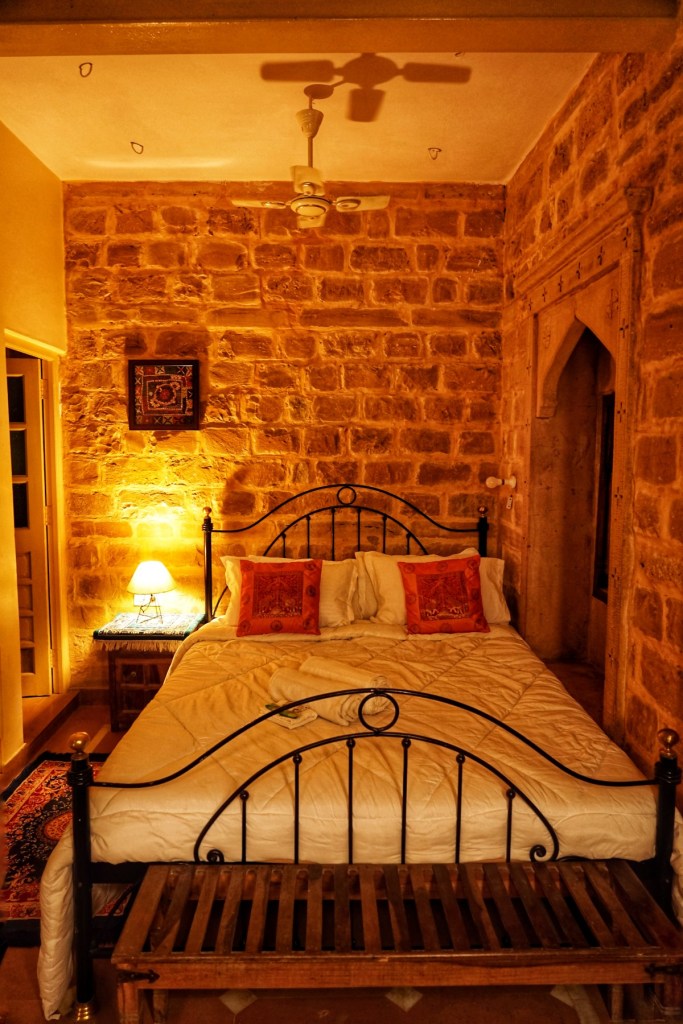
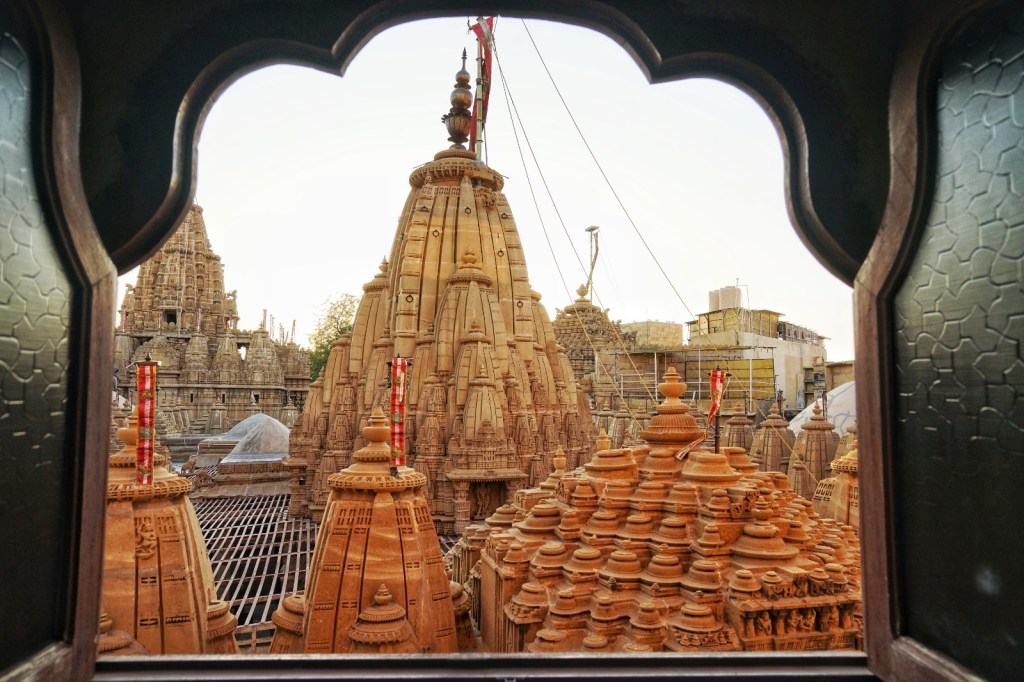
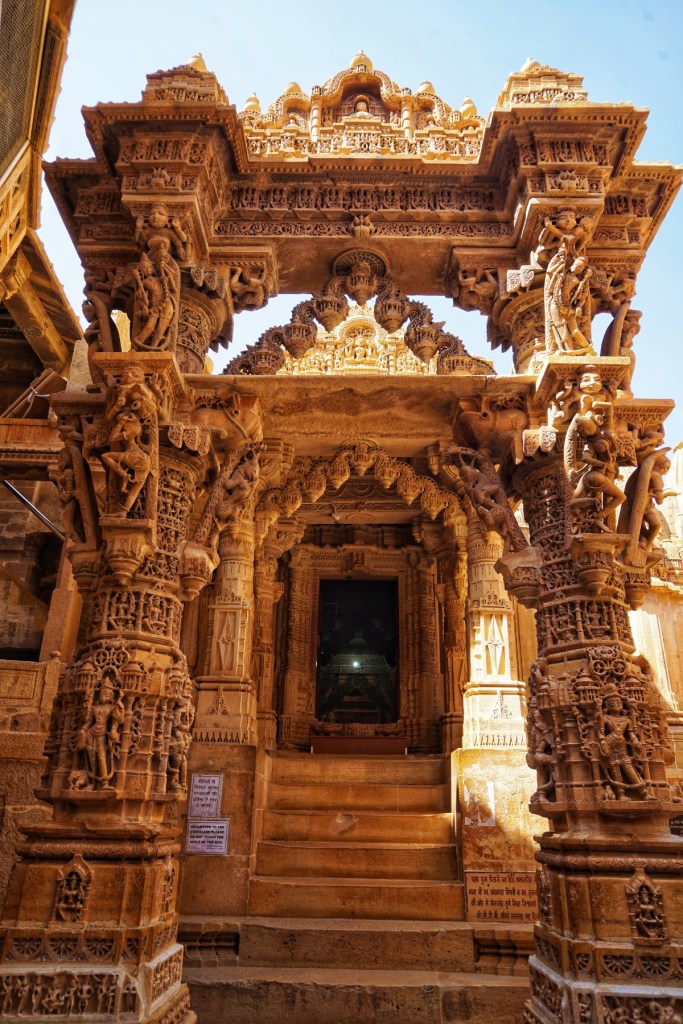
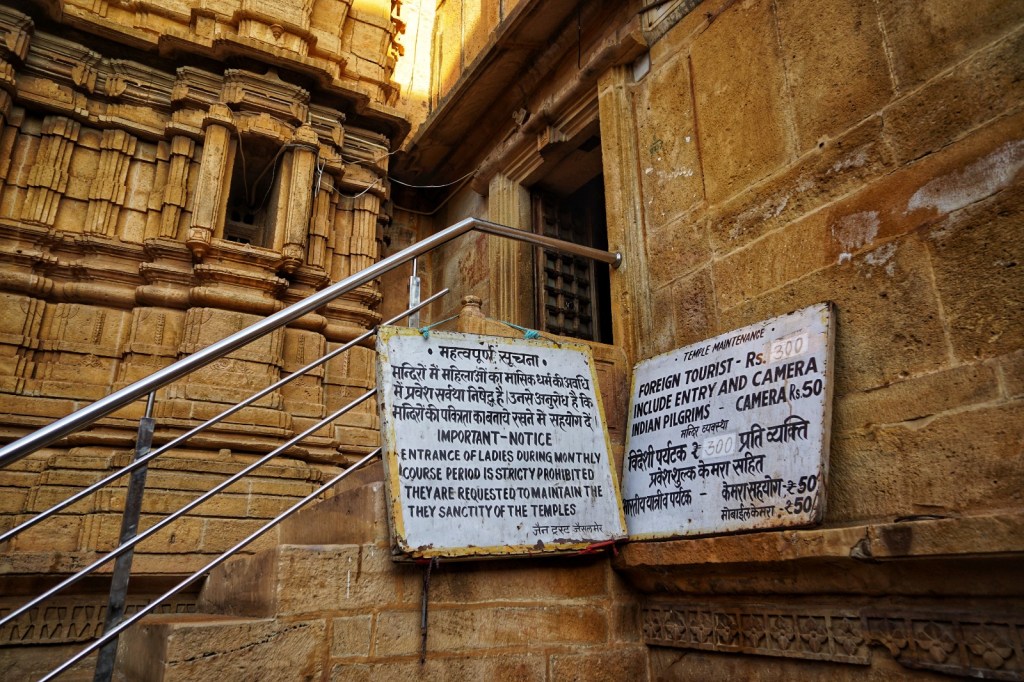
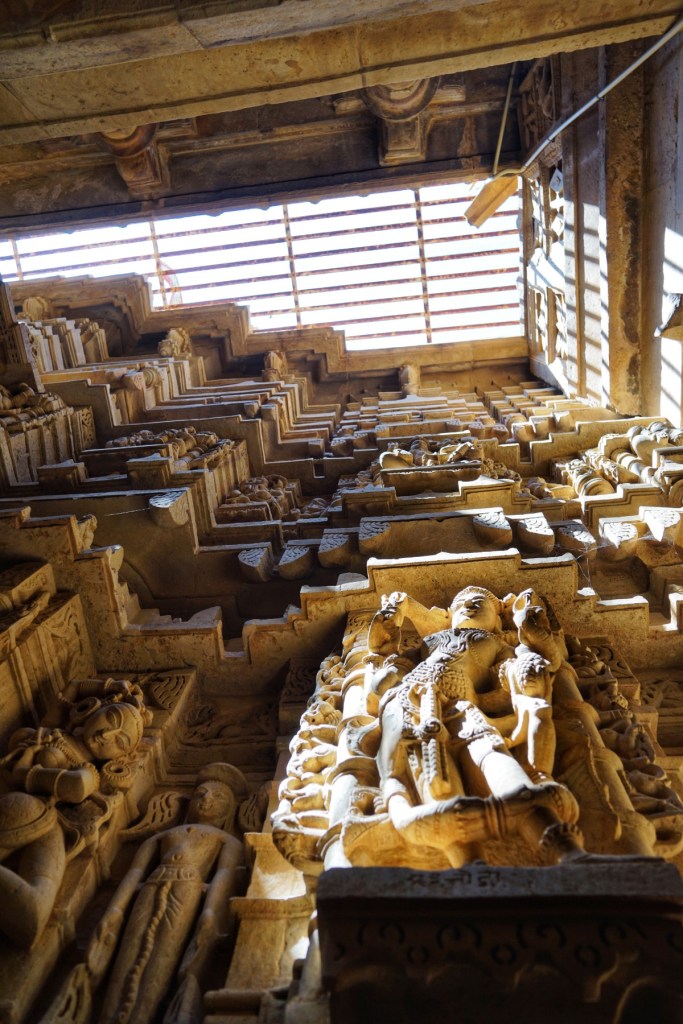
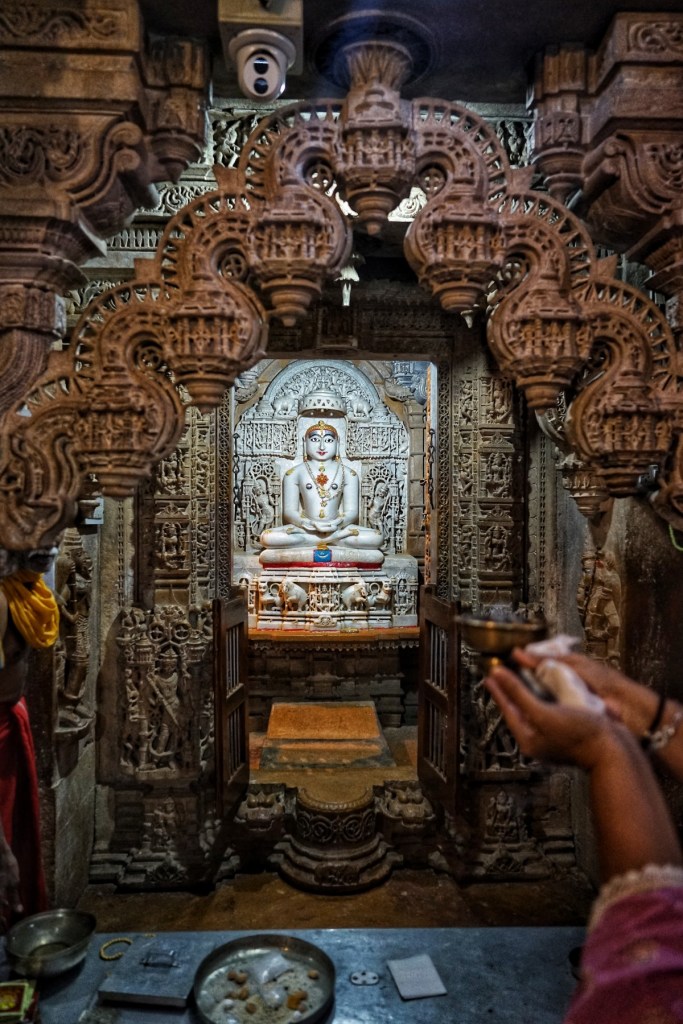
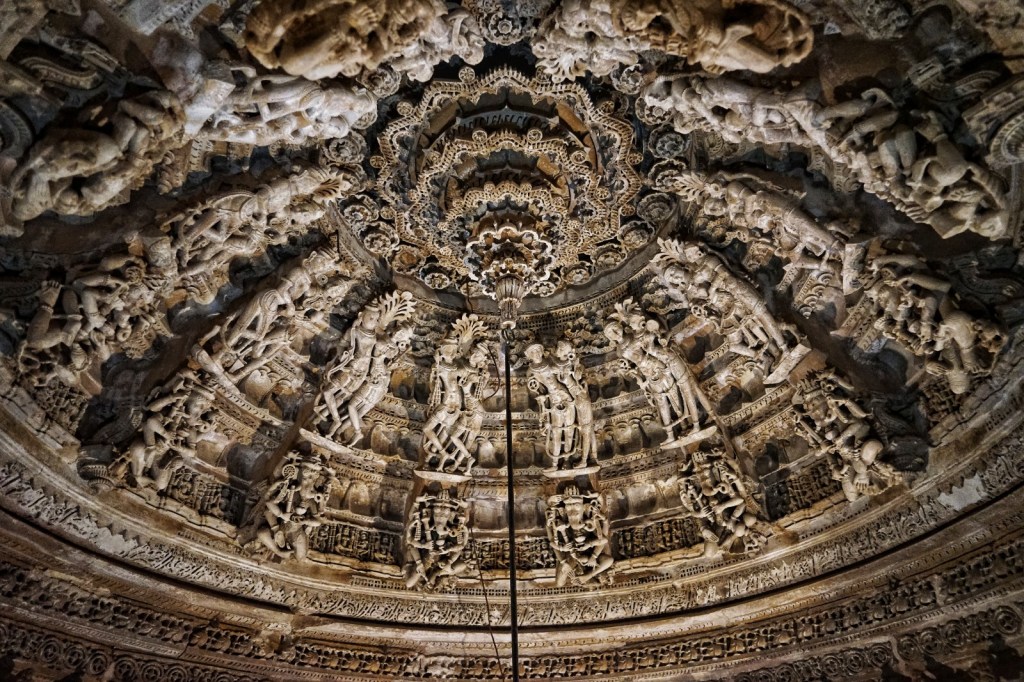
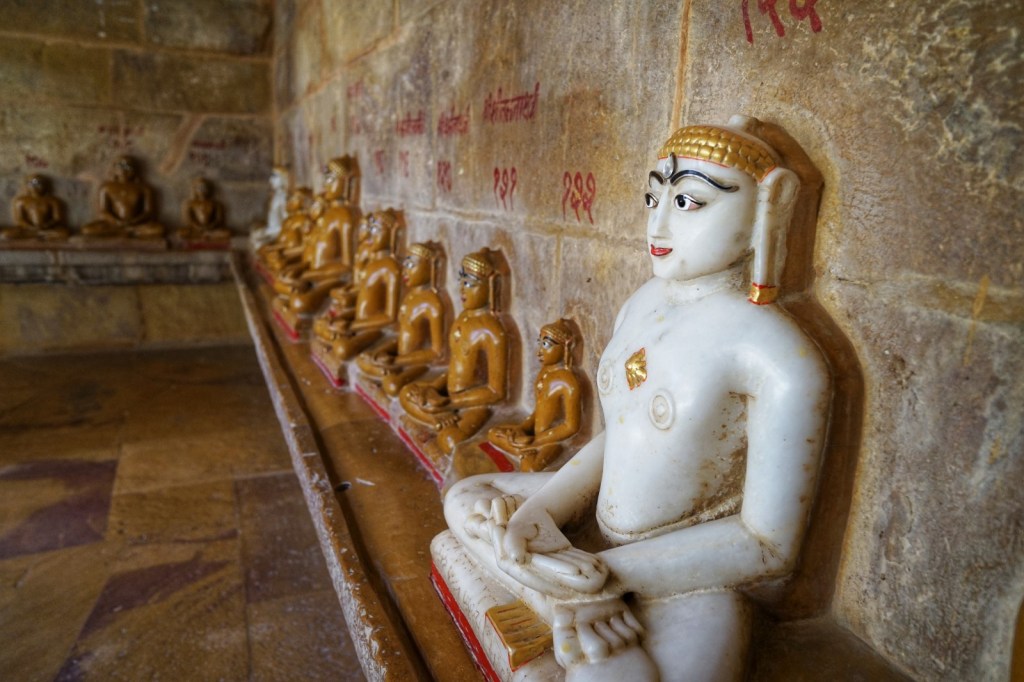
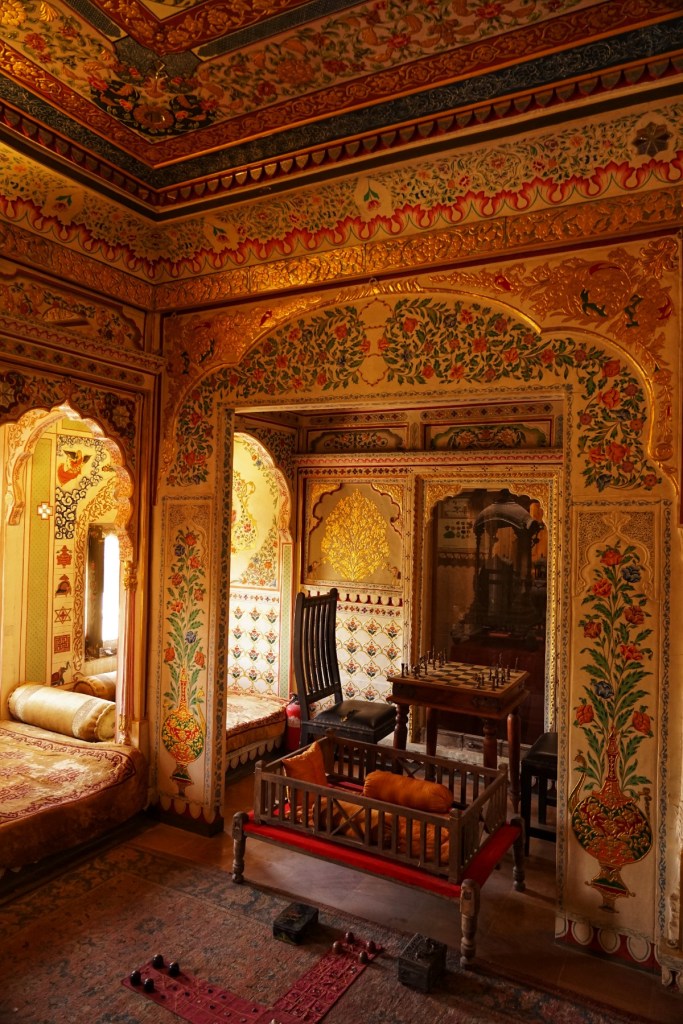
Soon, we feel like moving from outside the Fort to within. Almost by accident — just walking by — we meet our new host, who warmly welcomes us into one of his most beautiful rooms. It has a window seat that looks like it belongs in an oriental movie, with a direct view of the big Jain temple, that we soon visit ourselves. Here I feel peaceful, connected and the religion that beforehand I knew nothing inspired me quickly to read up about it. Jainism is one of the oldest religions in India, rooted in principles of non-violence, truth, and non-attachment. At its core lies a deep respect for all living beings — to the extent that some followers avoid harming even the smallest insects. In Jaisalmer, this philosophy is not only practiced but also visibly embedded in the city’s architecture. The Jain temples inside the Fort, built between the 12th and 16th centuries, are intricately carved from the same golden sandstone, yet feel almost weightless in their detail. Jaisalmer became an important center for Jain traders along ancient caravan routes, which helped the religion flourish here — leaving behind both spiritual and cultural imprints that still shape the city today.
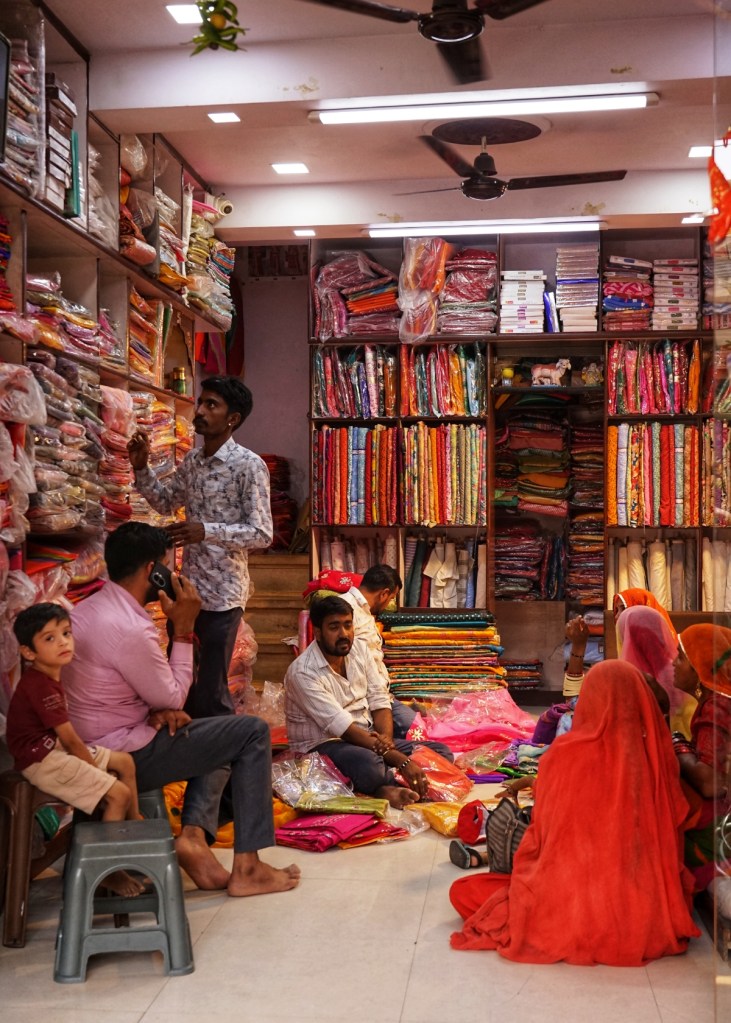
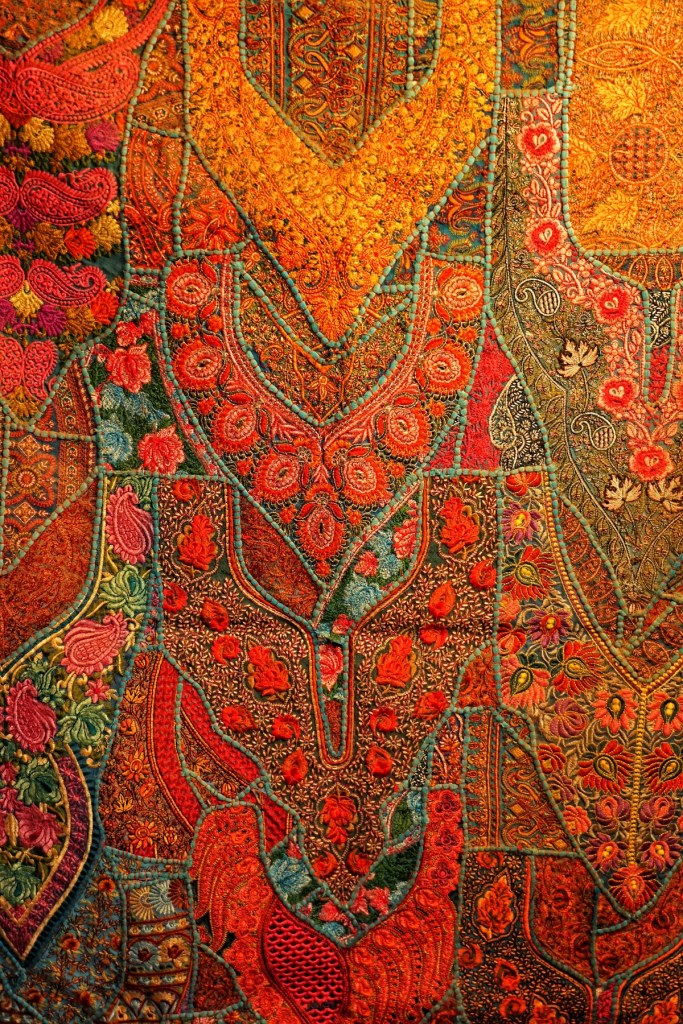
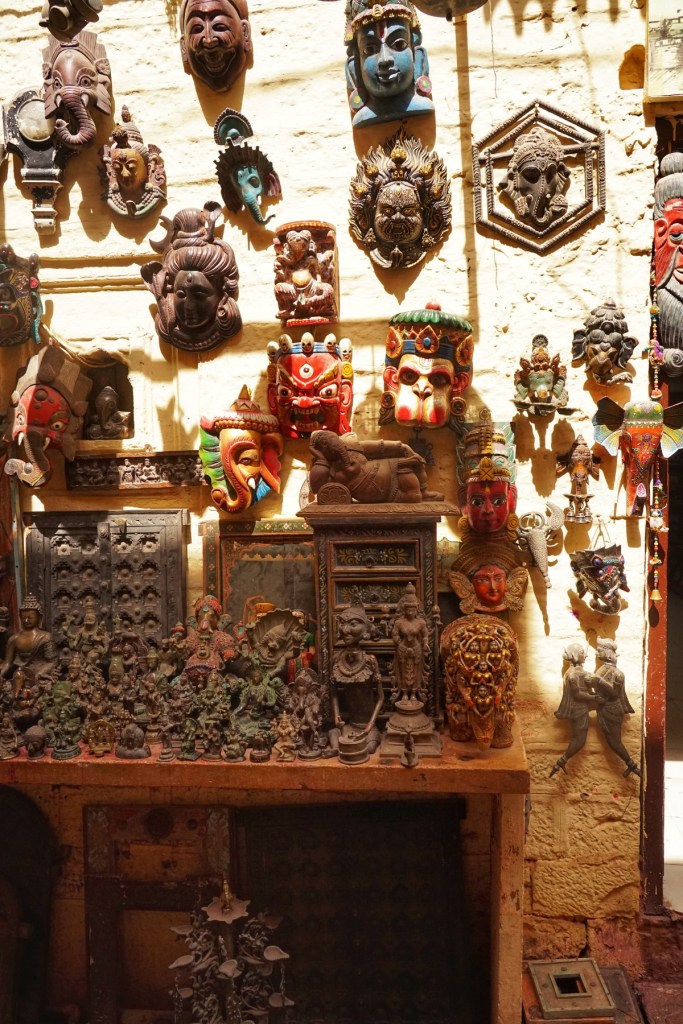
Jaisalmer is the dream destination of all my embroidery fantasies. Everywhere, in the streets, you stumble across textiles in every imaginable color — carpets, wall hangings, pillows, clothes, bags. My bag slowly fills with everything I’ve ever admired on Etsy and could never quite justify buying. Here, somehow, it feels different.
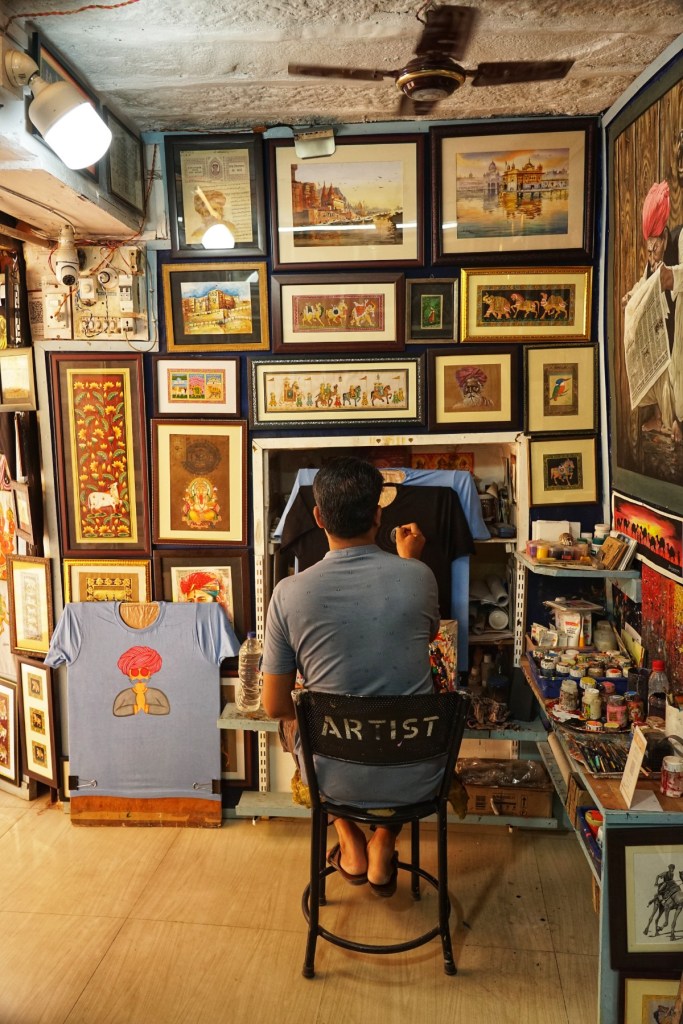
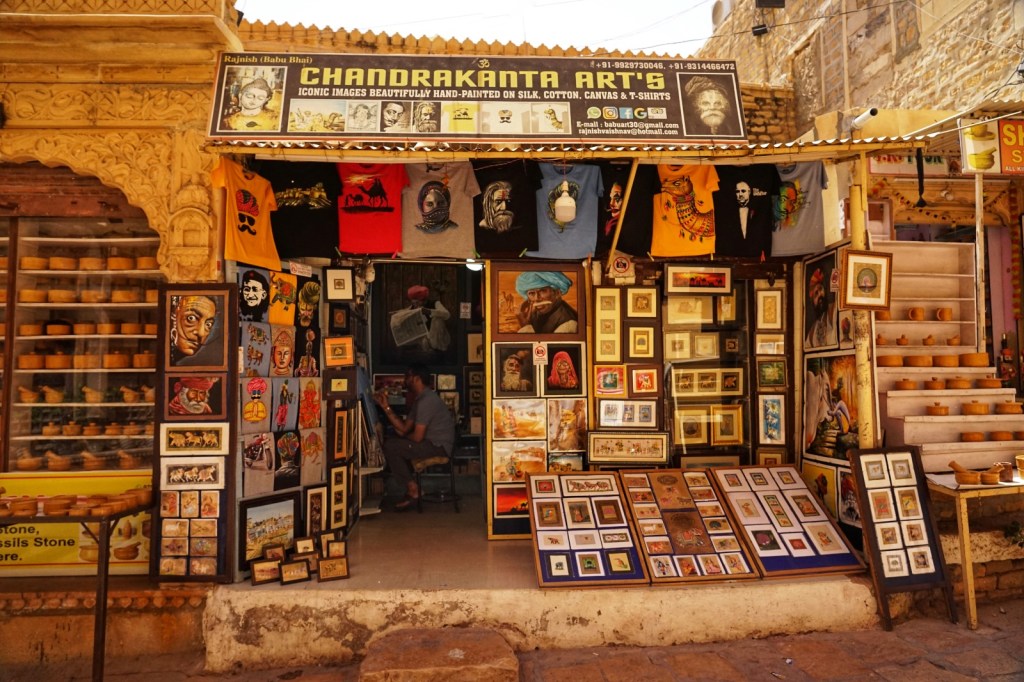
But it doesn’t stop there. Rajasthan is also known for its tradition of miniature painting, so we find ourselves stepping into a small shop and studio. Miniature painting in Rajasthan dates back centuries, once practiced in royal courts, where artists created highly detailed scenes of mythology, court life, and nature using the finest brushes — sometimes made from a single hair. Even today, the process is slow and precise, each line carefully placed, each color built up layer by layer. Inside, we meet a whole family who have been practicing this craft for generations. They work side by side, sharing techniques, developing new ideas together. It feels not simply like a business and more like a quiet continuation of something much older. We are invited for chai into their home, sitting together on a bed, talking, laughing, sharing a moment that feels simple and generous at the same time. Willem Jan ends up placing a commission for two T-shirts, and we buy two paintings on rolled canvas — pieces that will travel with us all the way back to Europe.
This little Fort town quickly turns into a place where we want to linger longer, and we start scratching places from our Rajasthan itinerary, leaving us with only Udaipur before returning to Mumbai. This allows us not only to connect more deeply with the place and its people, but also with ourselves — and the question of whether we want to visit the desert, and how. Willem Jan dreams of the dark night sky, I of sand dunes and wildlife. We both want to experience it in the most connected way. No glamping tents, no party scene — something grounded. Without really knowing what that means or how to achieve it. Since arriving in Jaisalmer, we’ve been flooded with offers for “non-touristy” desert safaris. All of them, in the end, follow the same pattern: driving for hours into the desert by jeep, stopping at certain oases or villages or ruins, eventually meeting some camels and continuing on their backs. Sleeping on simple beds under the open sky — or, depending on budget, in something that calls itself a tent but feels more like a glamping setup. Everyone assures us their experience is different. Less crowded. More authentic. And, more pressing for me: that their camels are treated well. But when I ask how many people sit on one camel, the answer is too often two. And when we ask how long the rides last, the answer is, again, too often two hours. The offers range from 3,000 to 4,500 rupees. And none of them feel right. To be honest, if Willem Jan hadn’t kept pursuing it, I probably wouldn’t have seen the desert. And definitely wouldn’t have ridden a camel. But I did. Because the longer we stay in Jaisalmer, the more things seem to quietly point us toward Khuri — a very small village, about 45 kilometers from Jaisalmer, reached by local bus. To Badal House. To one of their camel tours.
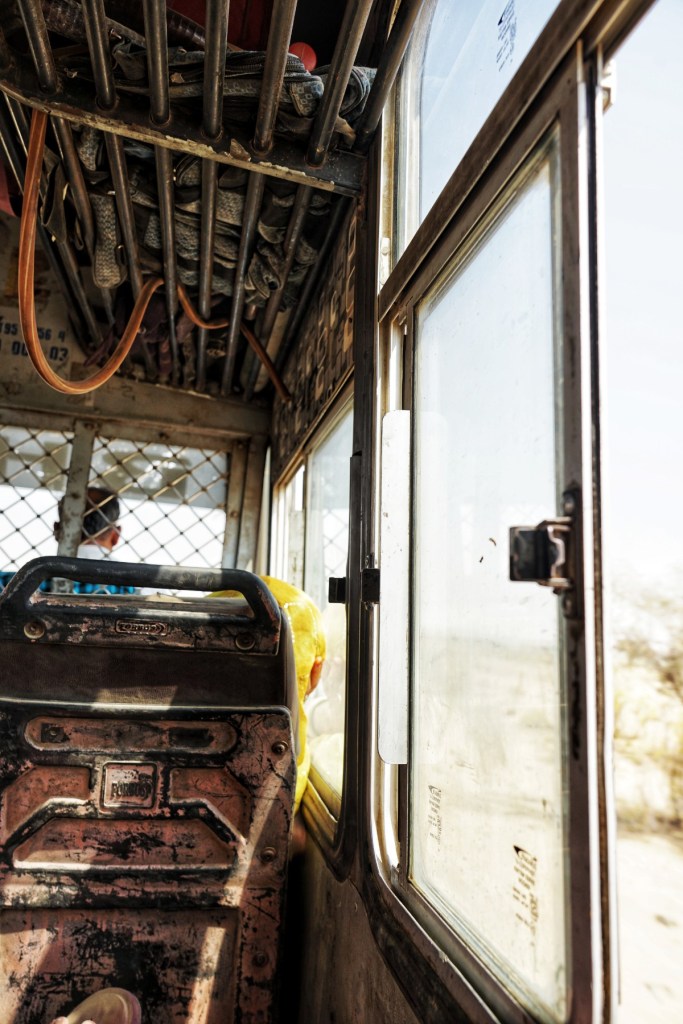
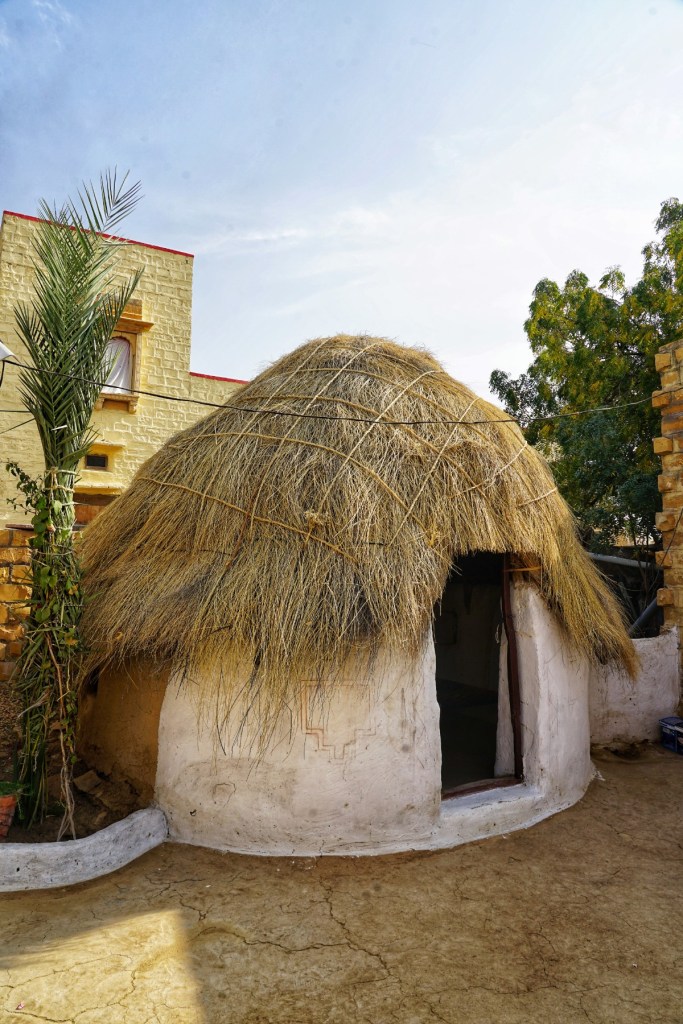
When we arrive with the bus, dusty and a little unsure of what exactly we are heading into, Sarup, our camel guide is already waiting for us. He greets us with an ease that stands in contrast to my inner world. Because I am still very much hesitant. Our original plan was to spend a night in the traditional mud house of Badal house. In the quiet shadow of straw and the soft welcoming voice of Badal himself. To arrive slowly. To meet the camels first, get a feeling for them and the guide — and then decide. Now, suddenly, everything is faster. More immediate. Iam feeling very much overwhelmed and need a moment. A long one. And, a nudge from Willem Jan.
I lie on the metal-framed bed and breathe, while Willem Jan talks to the host, doing his social magic. It gives me the space I need to settle, to ease into it. After a while I step out of the hut, a little shy, still slightly shaken. Badal’s kind smile softens that. And then there is xx — one of Badal’s cows. She wanders freely during the day and returns in the evening for food. She doesn’t give milk anymore, but she is still part of the family. I try to gently touch her. She is not particularly fond of strangers and shakes her head so violently that it startles me. Badal, Sarup, and Willem Jan burst out laughing. I join and any tension that was still lingering is gone.
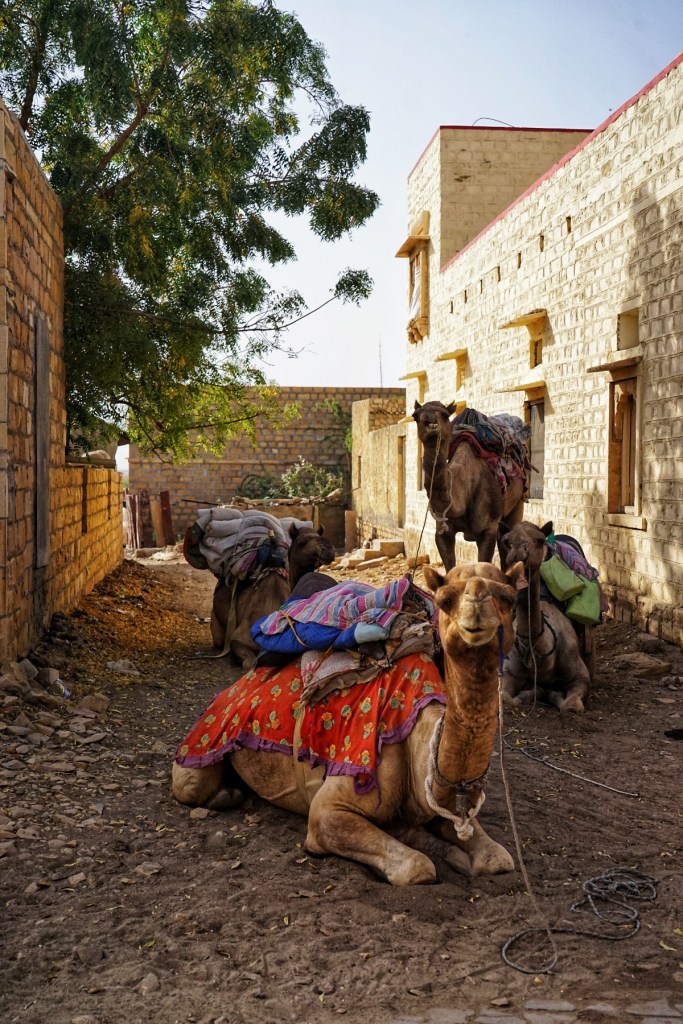
I watch Sarup as he prepares the animals: Bob Marley and Michael Jackson are the names of the ones we will ride. Blanket on blanket, padding on padding, then the saddle, tightened carefully with straps. More layers added — extra cushioning for our European buds. No decoration. No bells, no tassels, no unnecessary embellishment. But the moment that makes me step into it fully happens elsewhere. In what he seems to think is an unobserved moment, Sarup gently strokes Bob’s neck and leans his forehead against the camel’s long, soft fur. The camel responds by lowering its head onto his shoulder. And I know — this is right.
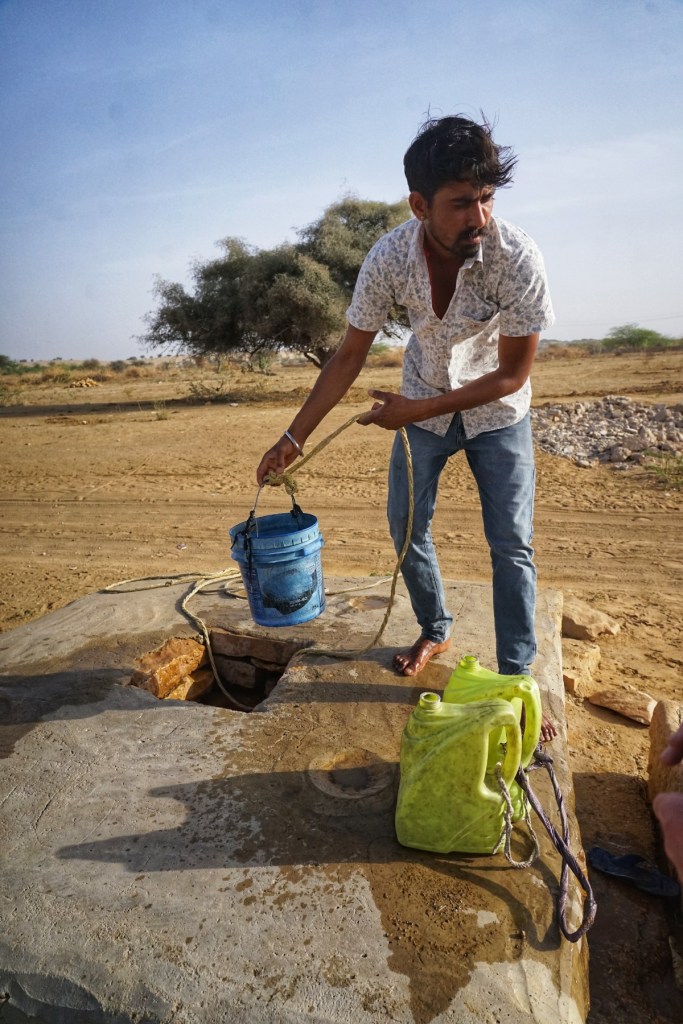
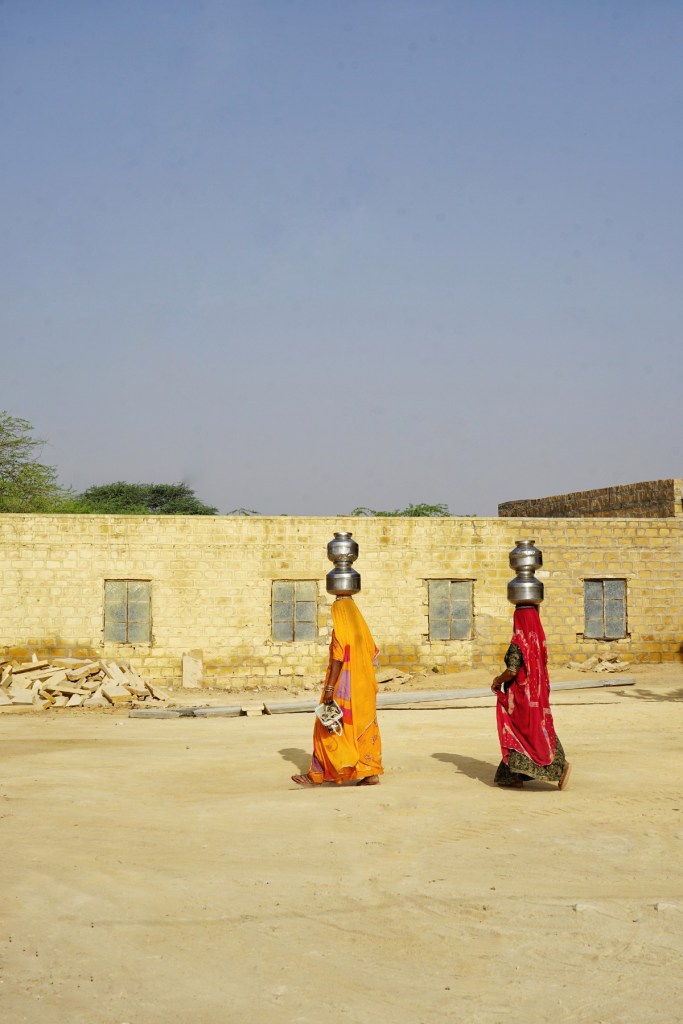
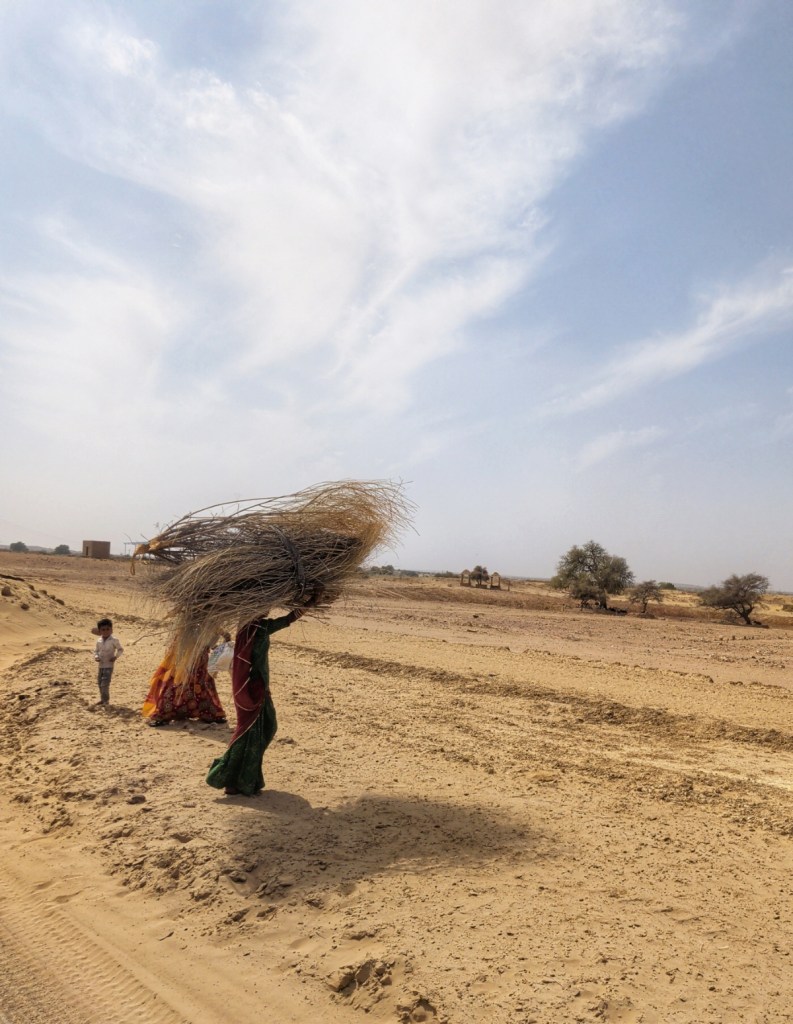
Riding out of the village, we make a quick stop at a well to gather water for the cooking later that night. Women carry large metal pots on their heads, laughing, joking with each other. When they notice us, they approach, asking for money — but with one quick nod from our guide, they turn and leave. And I feel relieved.
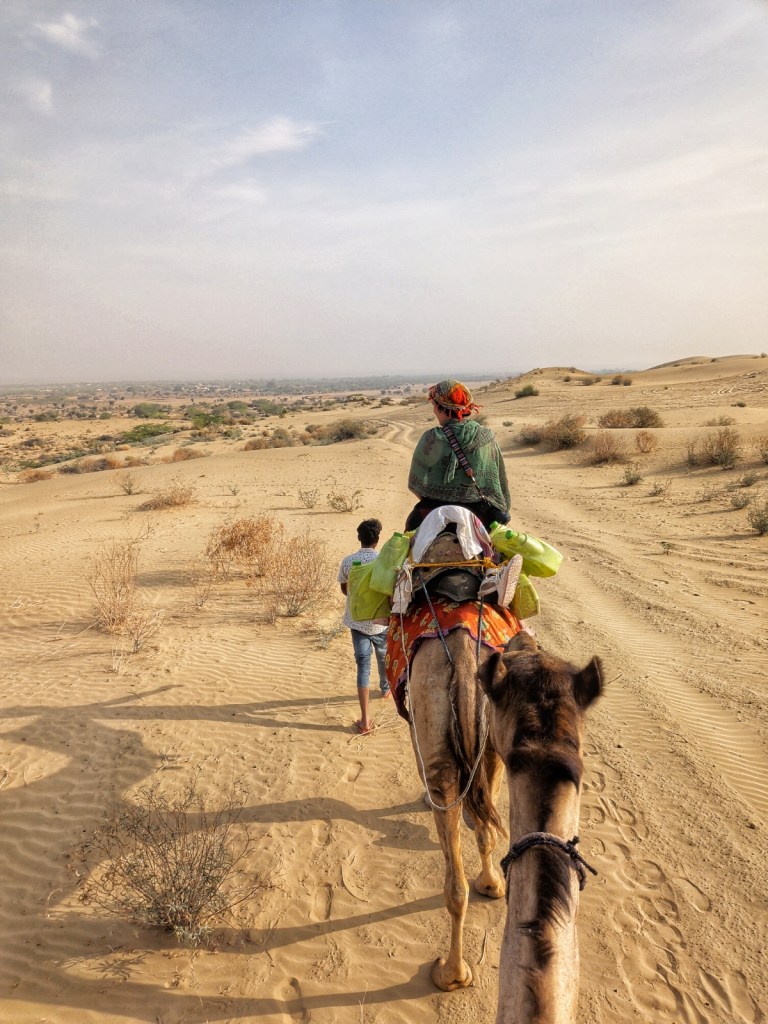
As we enter the desert, a dog joins us. His name is Badu, and he will stay with us the entire time we are out there. Keeping us company, but also, in his own way, protecting his flock. He always comes when Sarup has a tour. And even when he doesn’t, he still comes out here — to be with his companion. I like him more and more.
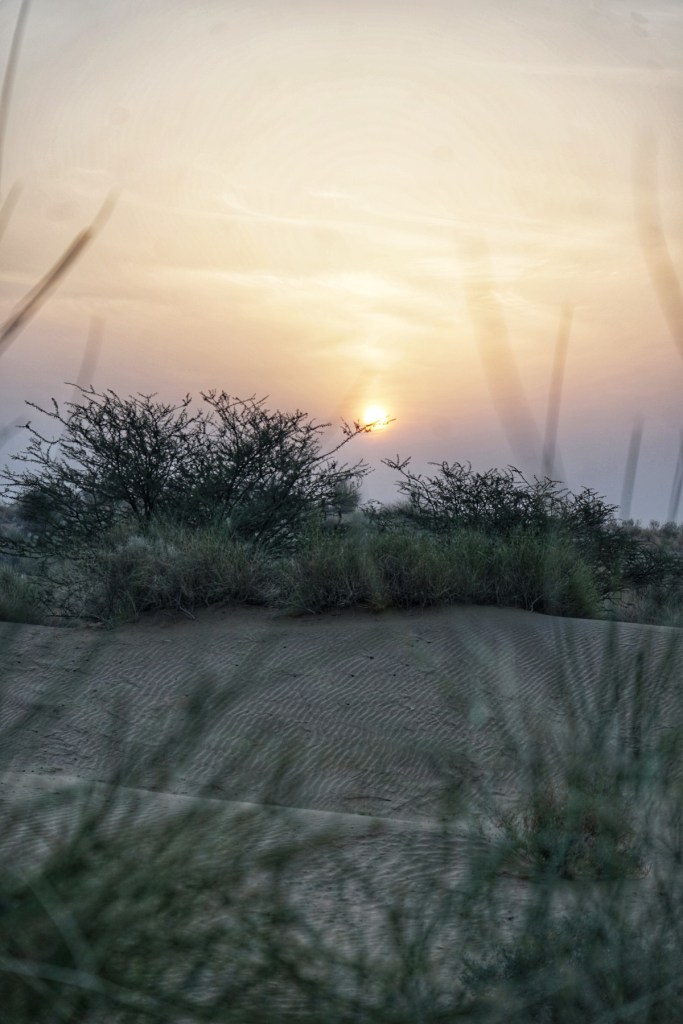
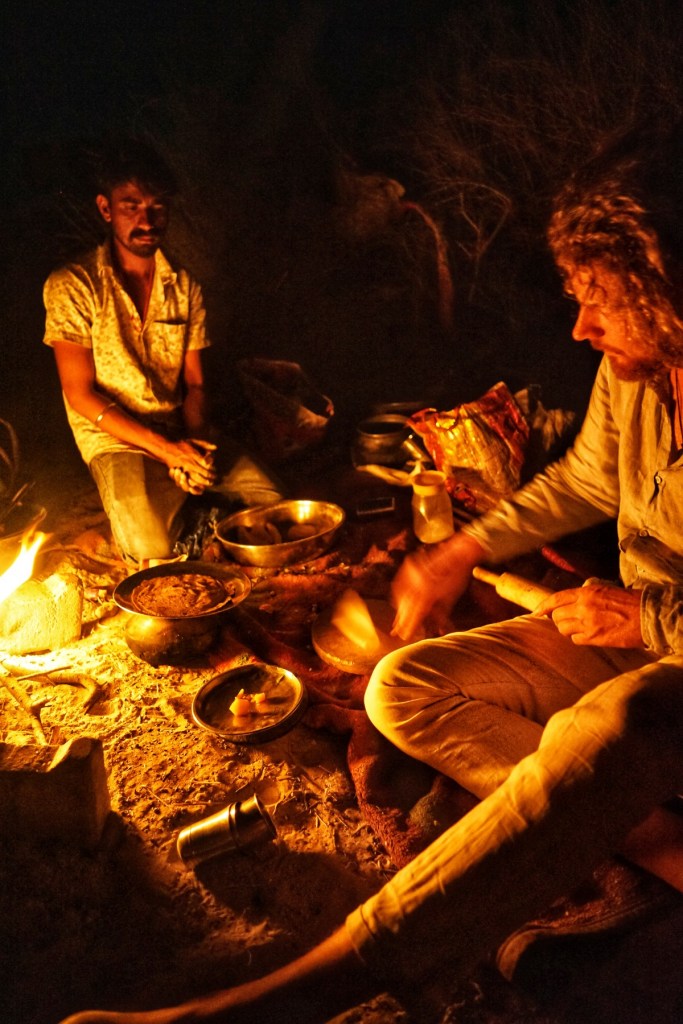
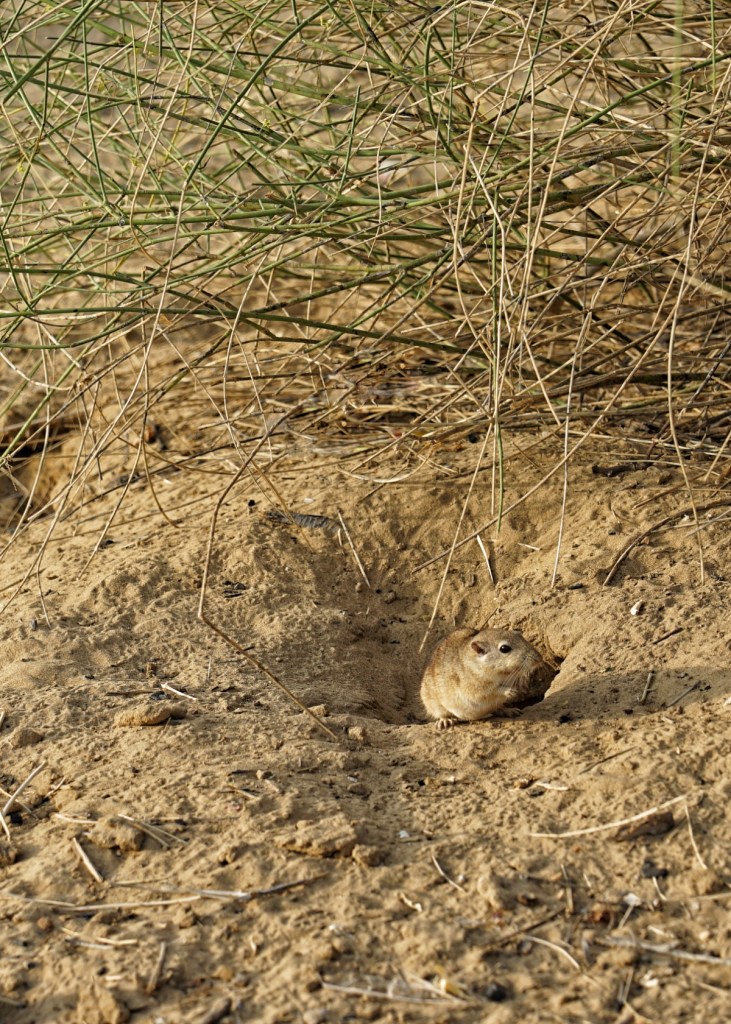
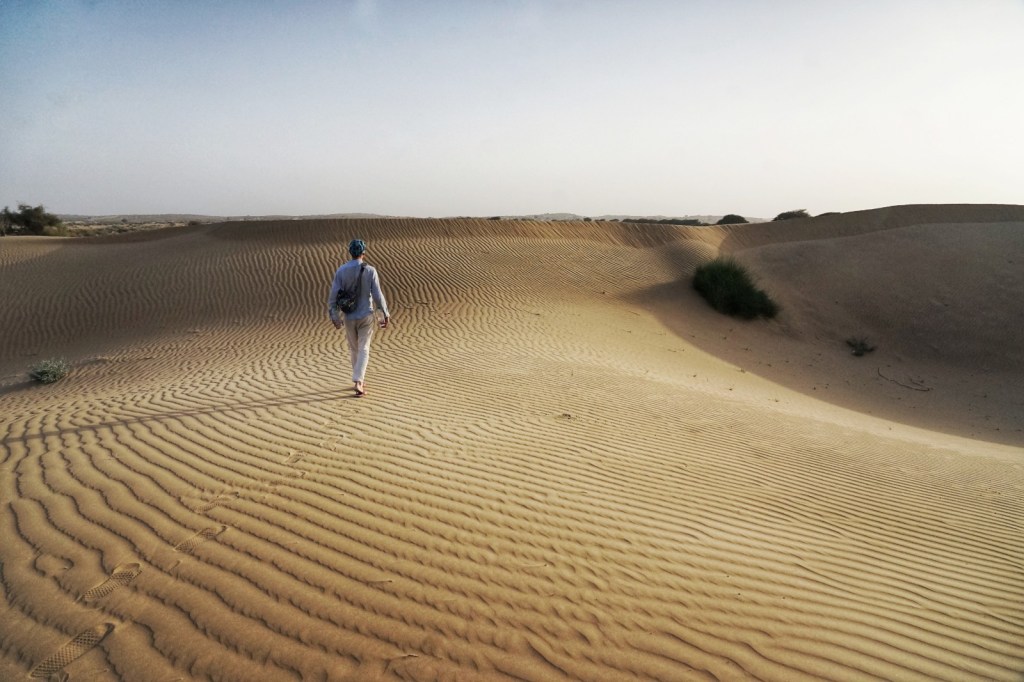
We ride for about forty minutes. Long enough to enjoy it, long enough for our buds. Again, I feel grateful we didn’t choose one of the other tours. A quiet thought that keeps returning throughout the evening. When we reach dunes that seem untouched, where no one else has set up camp. When Sarup starts preparing dinner, his cooking pot placed between the small holes of desert mice, making the best tea I had in India so far. When we make chapati together, rolling the dough in the sand-dry air. When Sarup sets up our beds — thick, cotton-filled blankets directly on the dunes, with a few more to cover us through the night. And his own, about twenty meters away, arranged in exactly the same way. When night settles in, and the only things we hear are the wind and Badu moving somewhere in the dark. And the only thing we see is the vast sky, scattered with what feels like millions of stars.
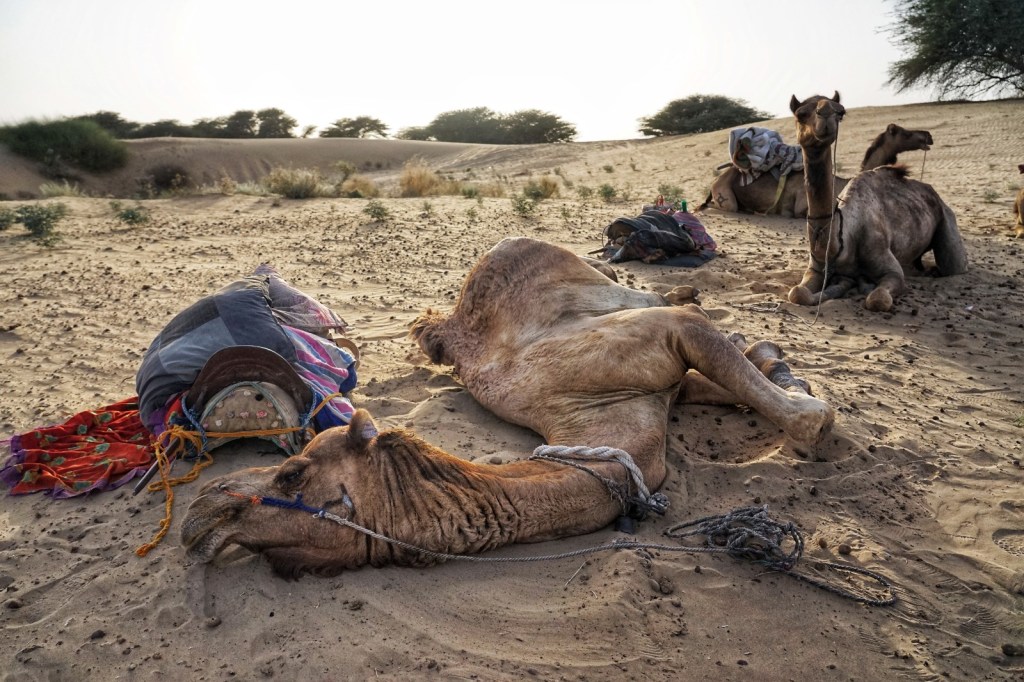
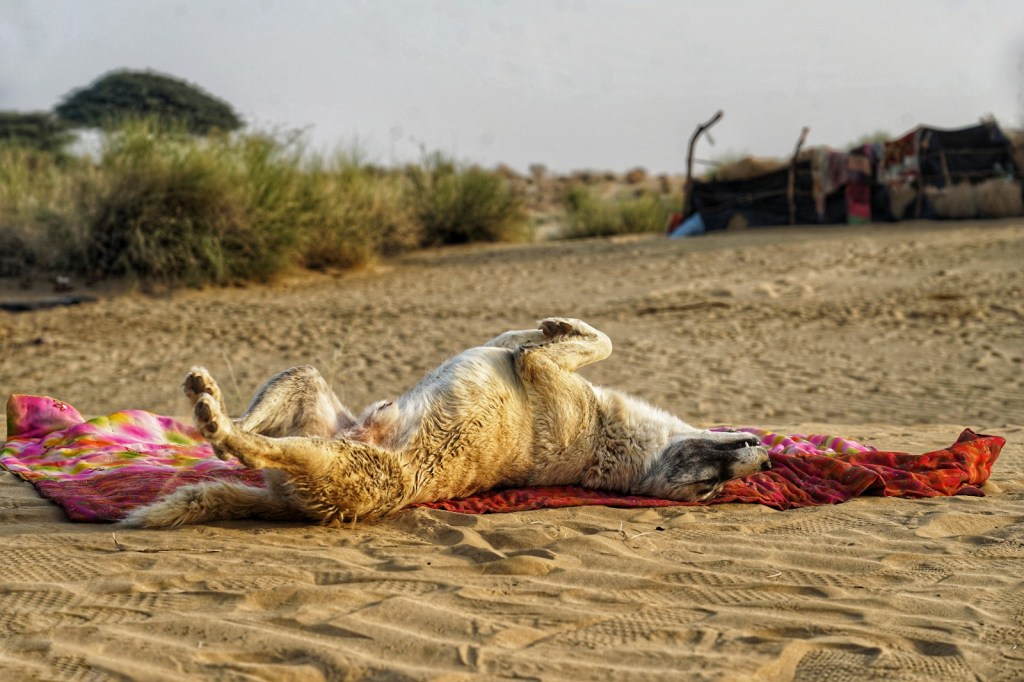
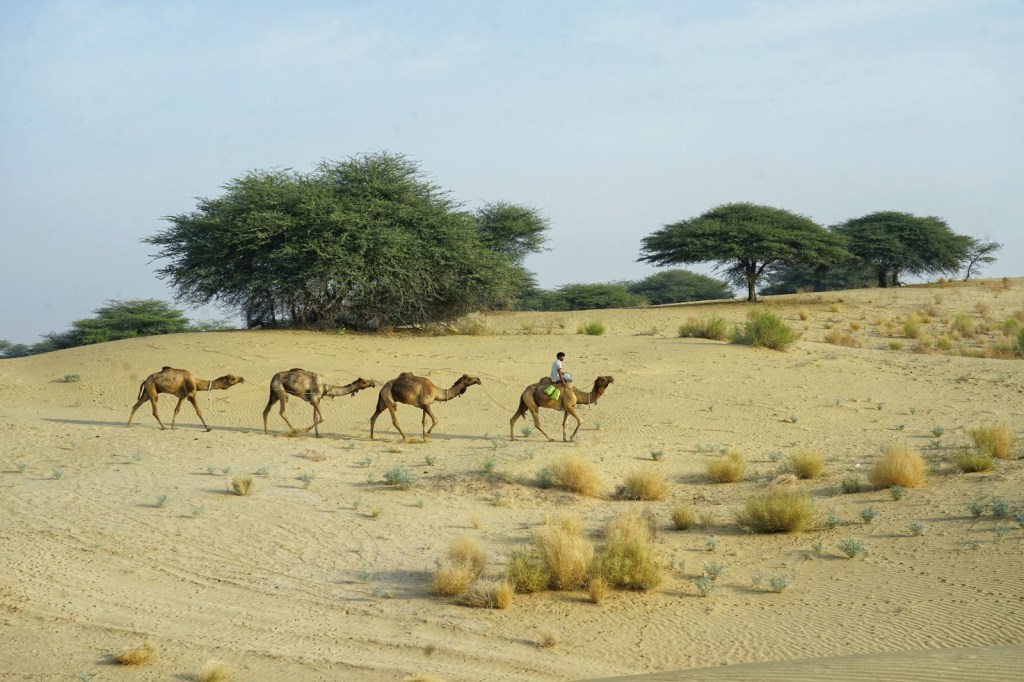
During this tour, we learn more about desert life than we expected — and we get to know our guide better. He speaks with glowing eyes about what he calls “camel college” — learning from and with the camels. Learning from the people he takes on tour. That’s how he has picked up an impressive range of languages, ranging from English to Korean.
Sarup is originally from Pakistan, from a nomadic family that has lived in the desert for generations. He has been working with camels since he was twelve. Back then, for larger companies — tours with up to twenty camels, each carrying two guests. Now, he runs his own small business. Because the other way felt too much. Too loud. Too hard on the camels. Now he has two of his own, the ones we are rising on. Two more he has borrowed from a friend, but he plans to buy them soon. The four of them make a good group, he says. The younger ones are two years old, still learning from the older ones, who are twelve and fourteen. Each of the young camels costs around 12,000 rupees. By the end of it, I feel a quiet impulse to simply give him the money. He never asked for it. And somehow, I know he wouldn’t accept it anyway.
He keeps talking while the rope he uses to lead the camels is loosely wrapped around his neck. If Bob were to run, it would probably snap Sarup’s head off. That is deep trust. I’m impressed.

But life is not all romantic here. Living in the desert can be harsh, as we learn through our newfound friends across town. The Indian government’s efforts to preserve the Fort — and, in parts, to turn it more into a controlled heritage site rather than a fully living space — create tension.
Jaisalmer Fort is one of the very few “living forts” left in the world, with, depending on who you ask, between 3,000 and 6,000 people still live inside. But that is also part of the problem. The infrastructure was never designed for modern life — water systems leak into the sandstone foundations, waste management is limited, and the sheer number of residents and tourists puts pressure on the structure. Over the years, parts of the Fort have even collapsed due to this strain. Preservation efforts often come with restrictions, and for the people living there, that can mean uncertainty, limitations, and — as we hear — more frequent power cuts and reduced services.
We also hear more about the struggles since Covid. Tourism, which many families here depend on, came to an almost complete standstill during the pandemic. Guesthouses stood empty, cafés closed, and incomes disappeared from one day to the next. Some returned to their villages, others tried to hold on, hoping for travelers to come back. Even now, there is a sense that things are slowly rebuilding — not quite as before, a bit more fragile, a bit more uncertain. You can feel it in conversations, in the way people speak about the past few years — not dramatically, but with a quiet honesty.
It also leads to the community sticking together. In the absence of tourists, people had to rely more on each other again. Local initiatives started to support healthcare, infrastructure, and small businesses. Families shared resources, helped maintain guesthouses even when no one was staying, and found ways to keep things going. There is a quiet resilience here — not performative, but practical. A kind of togetherness that feels lived, day by day.
In the end we stayed ten nights in this beautiful oasis of tranquility and ease. A pleasant place and stage after over two months in India. Jaisalmer adds a new flavour to the journey. One of inner stillness and easing into day to day desert life without much off inner and outer demand. A place that easily desolves in it’s surrounding. A quiet invitation to let the demanding mind dissolve into the not demanding heart.


If you feel like responding, I’m listening.