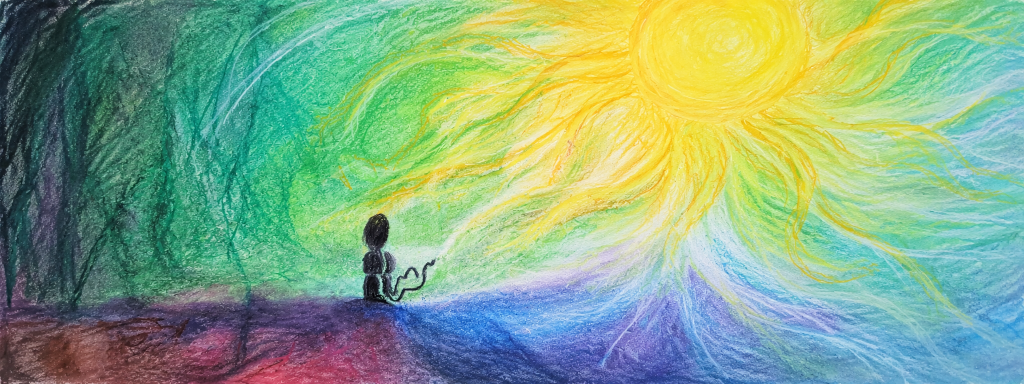
A day after the cremation, I had a meet-up with my psychiatrist. A routine check. Nothing special. She asked me how I was doing. I replied that I was sleeping badly. Nothing new. Nonetheless, for her it was obvious: I had experienced something traumatic. So my sleep was bad. Clear connection for her. Clear picture.
I didn’t answer.
The conversation went on.
These last weeks this word had come back to me again and again. This little word. I have become quite accustomed to it over the years. Still, hearing it the other day felt strangly off. Like a wrong note in a perfectly played music piece. I couldn’t quite put my finger on it. So I investigatetd further.
I looked up what traumatic actually means.
In a clinical context, “traumatic” means that something is experienced as deeply distressing or overwhelming, often in a way that exceeds a person’s ability to cope at the time.
It can refer to an event itself, or to its psychological impact. A traumatic experience can leave lasting effects such as fear, hypervigilance, avoidance, intrusive memories, or difficulty feeling safe.
Importantly, traumatic doesn’t necessarily mean one dramatic event. Repeated experiences, prolonged stress, loss, neglect, or other situations can also be experienced as traumatic.
Okay. I can see how this word has gained its importance. I can see why psychiatrists and psychologists use it. It gives a name to something. It can help make sense of what otherwise feels inexplicable. It can help us understand why something that happened years ago can still have a grip on the present.
I have had my fair share of these moments, you could say. And after hours and hours of psychotherapy, I have learned to refer to some of them as traumatic experiences.
They hurt me. Physically, mentally, and emotinally. There consequences stayed with me for years, some decades. There is no need to deny that.
But I have been asking myself since last week, since my psychiatrist sprang this word onto me: If I continue to see them as traumatic, do I really heal, change? Don’t I stay the victim? Forever? What if I no longer want to organise my life around them?
What if.
What if I can look at what happened and simply say: it happened.
Not good. Not bad. Not traumatic. Not formative. Not a wound I have to keep examining.
Just something that happened.
Something that was part of this lifes story.
Fast forward to now.
The word traumatic, in relation to the last weeks, is completely off.
Not because it wasn’t sometimes difficult. It was. There were moments of exhaustion, sadness, fear, uncertainty. But there was also laughter. Tenderness. Connection. Intimacy. There were moments that felt light, joyful and full of love.
Both sides are okay.
Both are important.
Both are the reason why these weeks have been a gift. Because they showed me, healed me, made me softer. They teached to let whatever is, be. The sadness. The anger. The fear. The emptiness. The love. Without having to turn any of it into a diagnosis, a category or a lesson.
And perhaps that is an invitation: to look at the stories we carry and, if we dare, turn them around. To question the words we have learned to use for them. It may feel obscene at first, even wrong. But sometimes a different perspective does not erase what happened. It simply gives us back the freedom to decide what place it gets to occupy in the life we are living now.


If you feel like responding, I’m listening.